Chemical SciencesWordPress

Henry Rzepa's Blog

Henry Rzepa's Blog
Chemistry with a twist
Home PageAtom Feed
language
Chemical ITArchive FormatsChemical StructureELNNuclear Magnetic ResonanceChemical Sciences
Published

At the ACS conference, I have attended many talks these last four days, but one made some “connections” which intrigued me. I tell its story (or a part of it) here. But to start, try the following experiment. Find a Word document of .docx type on your hard drive Remove the .docx suffix and replace it with a .zip suffix. Expand as if it is an archive (it is!). A folder is created and this itself contains four further folders.

Chemical ITAcademic PublishingChemicalChemical Information DivisionChemical NomenclatureChemical Sciences
Published

The upcoming ACS national meeting in San Diego has a CINF (chemical information division) session entitled "Global initiatives in research data management and discovery". I have highlighted here just one slide from my contribution to this session, which addresses the discovery aspect of the session. Data, if you think about it, is rarely discoverable other than by intimate association with a narrative or journal article.

Crystal_structure_miningInteresting ChemistryCity: San DiegoMetalNon-metalChemical Sciences
Published

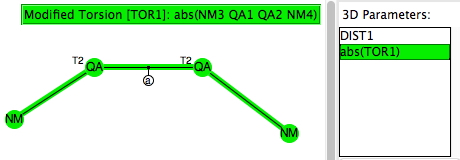
The upcoming ACS national meeting in San Diego has a CHED (chemical education division) session entitled Implementing Discovery-Based Research Experiences in Undergraduate Chemistry Courses. I had previously explored what I called extreme gauche effects in the molecule F-S-S-F. Here I take this a bit further to see what else can be discovered about molecules containing bonds between group 16 elements (QA= O, S, Se, Te).

Bond SlamHypervalencyAntibonding Molecular OrbitalAtomic OrbitalBlockChemical Sciences
Published

Hypervalency is defined as a molecule that contains one or more main group elements formally bearing more than eight  electrons in their  valence shell. One example of a molecule so characterised was CLi 6 [cite]10.1038/355432a0[/cite] where the description "“ carbon can expand its octet of electrons to form this relatively stable molecule ” was used.

Crystal_structure_miningHistoricalA Jahn-TellerBond LengthChemical ConceptsChemical Sciences
Published

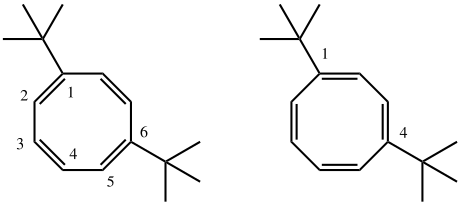
The phenomenon of bond stretch isomerism , two isomers of a compound differing predominantly in just one bond length, is one of those chemical concepts that wax and occasionally wane.[cite]10.1016/S1631-0748(02)01380-2[/cite] Here I explore such isomerism for the elements Ge, Sn and Pb. In one earlier post, I noted a form of bond stretch isomerism that can arise from a Jahn-Teller distortion ending in two different geometries

Chemical ITAcademic PublishingEuropean UnionFirst Open ScientistFirst SecretaryChemical Sciences
Published

I attended the first (of a proposed five) workshops organised by LEARN (an EU-funded project that aims to .. .Raise awareness in research data management (RDM) issues & research policy ) on Friday. Here I give some quick bullet points relating to things that caught my attention and or interest. The program (and Twitter feed) can be found at https://learnrdm.wordpress.com where other's comments can also be seen.

GeneralInteresting ChemistryChemical BondChemical BondingElectronChemical Sciences
Published

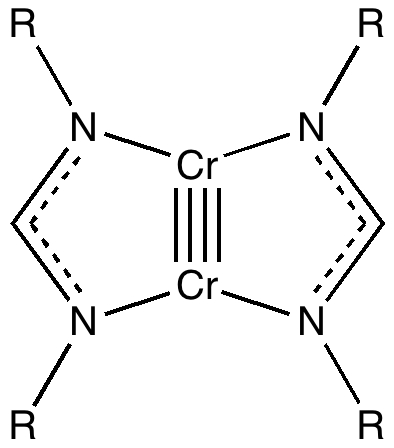
Six years ago, I posted on the nature of a then recently reported[cite]10.1002/anie.200803859[/cite] Cr-Cr quintuple bond. The topic resurfaced as part of the discussion on a more recent post on NSF 3 , and a sub-topic on the nature of the higher order bonding in C 2 . The comment made a connection between that discussion and the Cr-Cr bond alluded to above.

Reaction MechanismAqueous SolutionBrian ChallisCan construct Quantum-chemical modelsComputed Free Energy Barrier MatchesChemical Sciences
Published

The original strategic objective of my PhD researches in 1972-74 was to explore how primary kinetic hydrogen isotope effects might be influenced by the underlying structures of the transition states involved. Earlier posts dealt with how one can construct quantum-chemical models of these transition states that fit the known properties of the reactions.

HypervalencyChemical BondChemical BondingElectronLone PairChemical Sciences
Published

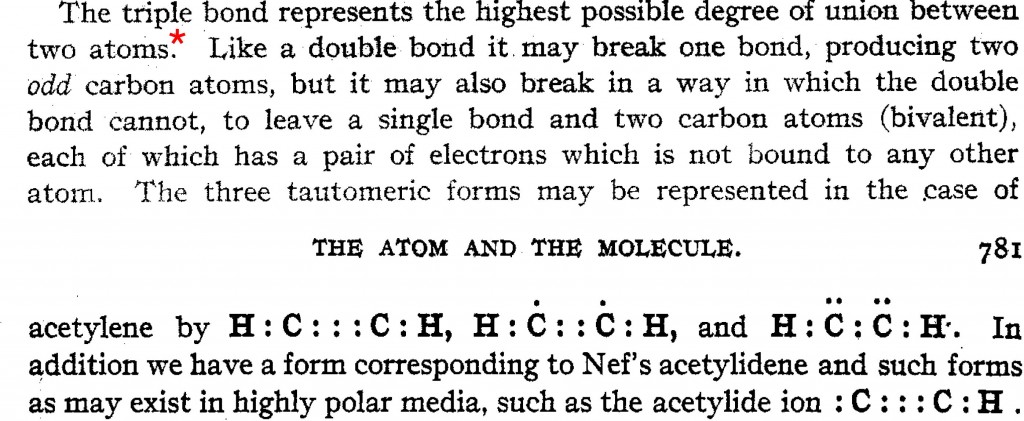
The post on applying VSEPR ("valence shell electron pair repulsion") theory to the geometry of ClF 3 has proved perennially popular. So here is a follow-up on another little molecue, F 3 SN. As the name implies, it is often represented with an S≡N bond. Here I take a look at the conventional analysis. This is as follows: Six valence electrons on the central S atom.