Chemical SciencesWordPress

Henry Rzepa's Blog

Henry Rzepa's Blog
Chemistry with a twist
Home PageAtom Feed
language
Interesting ChemistryFree EnergyMöbius KnotMöbius LinkPericyclicChemical Sciences
Published

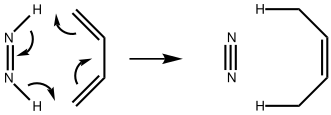
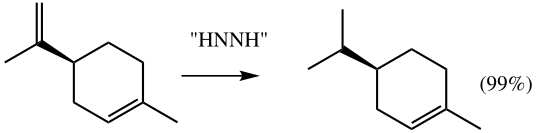
I was intrigued by one aspect of the calculated transition state for di-imide reduction of an alkene; the calculated NMR shieldings indicated an diatropic ring current at the centre of the ring, but very deshielded shifts for the hydrogen atoms being transferred. This indicated, like most thermal pericyclic reactions, an aromatic transition state.
Interesting ChemistryMetal WireChemical Sciences
Published

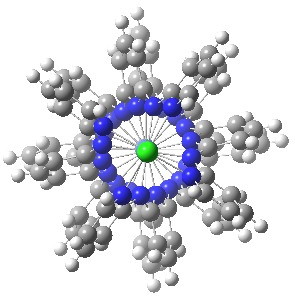
More than 60 million molecules are known, and many are fascinating. But beauty is in the eye of the beholder. Thus it was that I came across the attached molecule. It struck me immediately as, well, beautiful!

Interesting ChemistryAgostic InteractionPi ComplexReaction MechanismChemical Sciences
Published

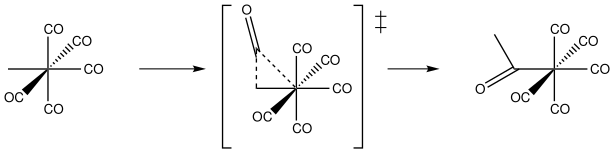
When methyl manganese pentacarbonyl is treated with carbon monoxide in e.g. di-n-butyl ether, acetyl manganese pentacarbonyl is formed. This classic experiment conducted by Cotton (of quadruple bond fame) and Calderazzo in 1962 dates from an era when chemists conducted extensive kinetic analyses to back up any mechanistic speculations. Their suggested transition state is outlined below.

Interesting ChemistryImmediate ProductInversionReaction MechanismTriflate LeavingChemical Sciences
Published

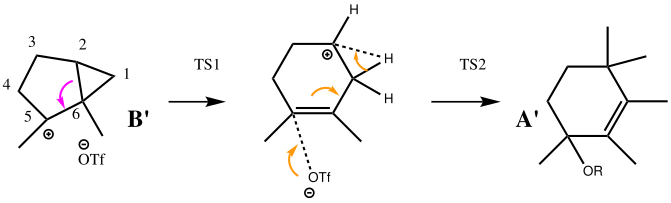
The reaction described in the previous post (below) is an unusual example of nucleophilic attack at an sp2-carbon centre, reportedly resulting in inversion of configuration. One can break it down to a sequence of up to eight individual steps, which makes teaching it far easier. But how real is that sequence?

Chemical KnowledgeReaction MechanismResearcherTutorial MaterialChemical Sciences
Published

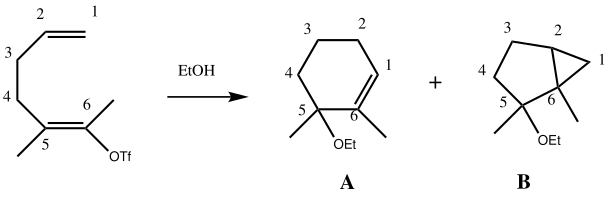
The reaction below plays a special role in my career. As a newly appointed researcher (way back now), I was asked to take tutorial groups for organic chemistry as part of my duties. I sat down to devise a suitable challenge for the group, and came upon the following reaction.

Interesting ChemistryIron ComplexMetalPostscriptChemical Sciences
Published

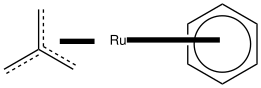
Every once in a while, one encounters a molecule which instantly makes an interesting point. Thus Ruthenium is ten electrons short of completing an 18-electron shell, and it can form a complex with benzene on one face and a ligand known as trimethylenemethane on the other.