FeatureInformatikEnglisch
Veröffentlicht
Autor Martin Fenner
On Monday Jenny Rohn published a blog post Peer review is no picnic that concludes: As always with Jenny’s blog posts, the discussion is as interesting as the blog post itself.
On Monday Jenny Rohn published a blog post Peer review is no picnic that concludes: As always with Jenny’s blog posts, the discussion is as interesting as the blog post itself.
Last week BioMed Central published a draft position statement on open data (PDF). Iain Hrynaszkiewicz explained the statement on the BioMed Central Blog, including the five Ws of open data:Why make data more open?What data to make more open?Where to make data more open?When to make data more open?How to make data more open? Please comment on the statement.
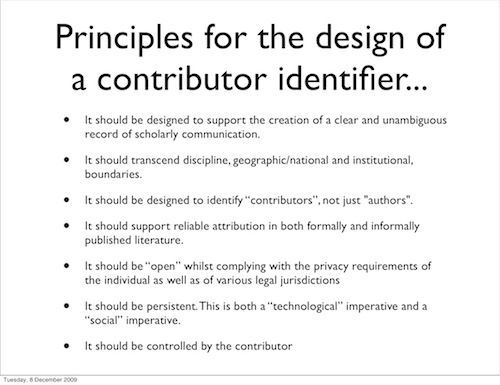
This was the title of the session with Geoff Bilder , Gudmundur Thorisson and myself at the Science Online London Conference last Saturday. Geoff first introduced the ORCID initiative, including several principles. We then talked about two use cases for ORCID.
The 3rd Annual Science Online London Conference took place last Friday and Saturday. For me it was again a fantastic event. Matt Brown is collecting all blog posts, pictures, videos, etc. over at this Nature Network post. As one of the organizers of the conference (mainly helping with the program) I was pretty nervous, and I have to admit that I didn’t sleep well Thursday and Friday. And much better Saturday.
The iPad owners among the PLoS BLOGs readers can use the free Flipboard application to read all the great content that is written by my fellow ploggers PLoGsters (as suggested by David Kroll). In Flipboard simply create a new section and then add content to it by following the @plosblogs Twitter account. There are of course many other ways Flipboard can be used to follow science blogs, e.g. by following the @researchblogs Twitter account.
On Wednesday PLoS BLOGs launched with a splash. We (both PLoS BLOGs as a whole and me individually) got a lot of positive feedback and words of encouragement – so we are off to a good start. As both our community manager Brian Mossop and myself are currently in London for the Science Online London Conference, we could celebrate the launch in person. With a good pint of British ale Thursday evening.

In his introductory post, PLoS community manager Brian Mossop talks about how PLoS Blogs came to life, and the lessons learned from other blogging networks. For me personally it all started a few weeks ago with a phone call one Friday evening from Pete Binfield, Publisher of PLoS ONE and the PLoS Community Journals. Since August 2007 and until today I was blogging over at Nature Network.

This is my last post for this Nature Network blog. Later today, I will start a new blog somewhere else – also called Gobbledygook and covering the same topics. Writing this blog here on Nature Network since August 2007 has been an incredible experience, something that can't be covered in a single blog post. I simply want to say thank you to all the people I interacted with over the years – both online and in person.
Elsevier on Saturday launched SciVerse, the new Elsevier platform that combines ScienceDirect (full-text journal articles) and Scopus (abstract and citation database of peer-reviewed literature). In 2011 SciTopics (research summaries) will also be integrated and outside developers will be able to build SciVerse applications (Elsevier and 3rd party tools that integrate with ScienceDirect and Scopus). Current users of Scopus and ScienceDirect can
On August 11, the Journal of Neuroscience published an Announcement Regarding Supplemental Material by Editor-in-Chief John Maunsell. In it John Maunsell announces that the journal in November will stop accepting supplementary material in article submissions. The announcement has lead to an extensive discussion in the science blogosphere with a number of relevant posts listed below[^1]: Drugmonkey : Yay!
In his new book Cognitive Surplus Clay Shirky argues that in the last 50 years many of those living in industrialized countries have seen a dramatic increase in free time, paired with better education and a higher standard of living. But a very large part of that free time or cognitive surplus is now routinely used to watch television, a passive activity that makes us a consumer rather than a participant.