ChemieEnglischWordPress

Henry Rzepa's Blog

Henry Rzepa's Blog
Chemistry with a twist
StartseiteAtom-Feed
language
GeneralEnergyEnergy PenaltyEnergy StabilisationFree EnergyChemieEnglisch
Veröffentlicht

In the previous post, I showed how modelling of unbranched alkenes depended on dispersion forces. When these are included, a bent (single-hairpin) form of C 58 H 118 becomes lower in free energy than the fully extended linear form. Here I try to optimise these dispersion forces by adding further folds to see what happens.

Chemical ITACSDOIGoogleHandleChemieEnglisch
Veröffentlicht

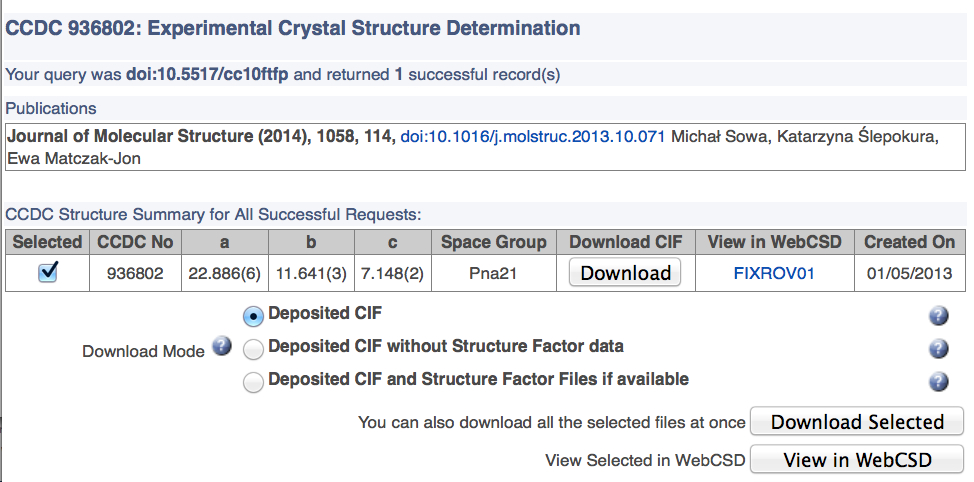
OK, you have to be British to understand the pun in the title, a famous comedy skit about four candles. Back to science, and my mention of some crystal data now having a DOI in the previous post. I thought it might be fun to replicate the contents of one of my ACS slides here. Firstly, a DOI is one implementation of a more generic (and quite old) concept known as a Handle. This is one form of a persistent digital identifier.

Chemical ITACSAmsterdamAmsterdam ManifestoDallasChemieEnglisch
Veröffentlicht

I have mentioned the Amsterdam manifesto before on these pages. It is worth repeating the eight simple principles: Data should be considered citable products of research. Such data should be held in persistent public repositories. If a publication is based on data not included with the article, those data should be cited in the publication.

GeneralBBCBritish Broadcasting CorporationProducerTomorrow's WorldChemieEnglisch
Veröffentlicht

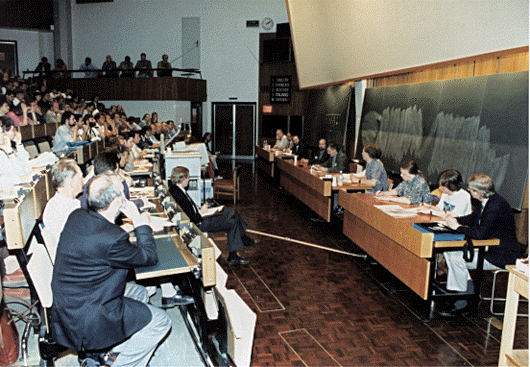
A short post this, to remind that today is officially the 25th birthday of the World-Wide-Web, in March 1989. It took five years for a conference around the theme to be organised and below is a photo from that event. (C) CERN Photo From my perspective and perhaps from the 200 or so others present at that closing session, I went back home and told my young children that the world had changed that week. So it has.

Interesting ChemistryReaction MechanismActivation EnergyAnimationAromaticChemieEnglisch
Veröffentlicht

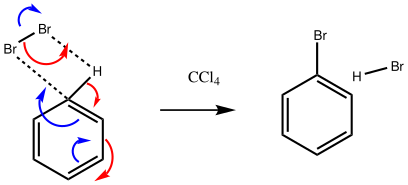
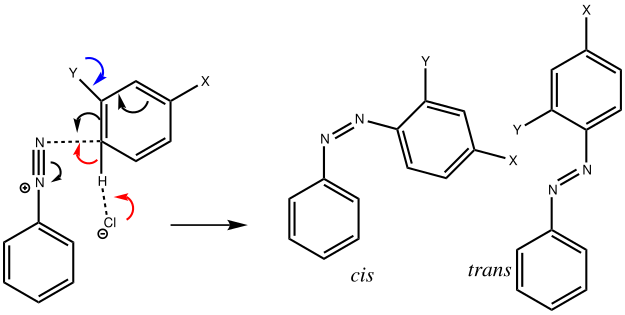
My previous post related to the aromatic electrophilic substitution of benzene using as electrophile phenyl diazonium chloride. Another prototypical reaction, and again one where benzene is too inactive for the reaction to occur easily, is the catalyst-free bromination of benzene to give bromobenzene and HBr.

Reaction MechanismChemieEnglisch
Veröffentlicht

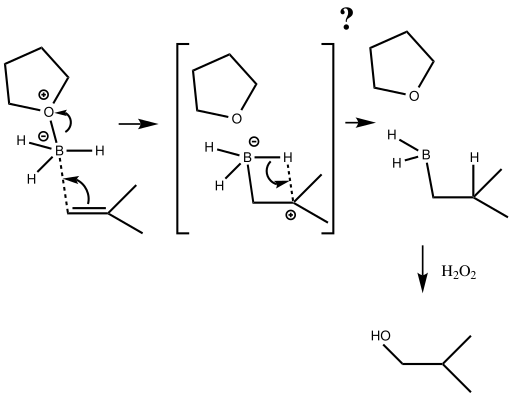
A staple of introductory undergraduate teaching in organic chemistry is Markovnikov’s rule, which states: “the addition of a protic acid HX to an alkene results in the acid hydrogen (H) becoming attached to the carbon with fewer alkyl substituents and the halide (X) group to the carbon with more alkyl substituents“. Shortly thereafter, students are exposed […]

PericyclicReaction MechanismPotential Energy SurfaceChemieEnglisch
Veröffentlicht

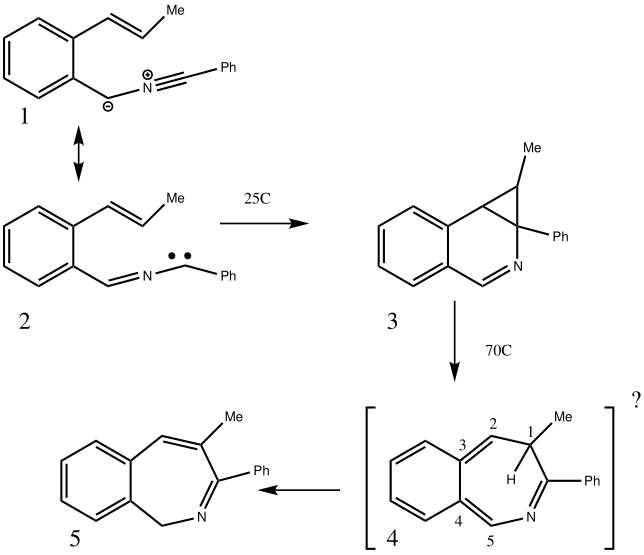
The potential energy surface for a molecule tells us about how it might react. These surfaces have been charted for thousands of reactions using quantum mechanics, and their basic features are thought to be well understood. Coming across an entirely new feature is rare. So what do you make of the following?