ChemieEnglischWordPress

Henry Rzepa's Blog

Henry Rzepa's Blog
Chemistry with a twist
StartseiteAtom-Feed
language
Acetic AcidReaction MechanismTutorial MaterialChemieEnglisch
Veröffentlicht

If you have not previously visited, take a look at Nick Greeves’ ChemTube3D , an ever-expanding gallery of reactions and their mechanisms. The 3D is because all molecules are offered with X, Y and z coordinates. You also get arrow pushing‡ in 3D. Here, I argue that we should adopt Einstein, and go to the space-time continuum!
GeneralE-booksTutorial MaterialChemieEnglisch
Veröffentlicht

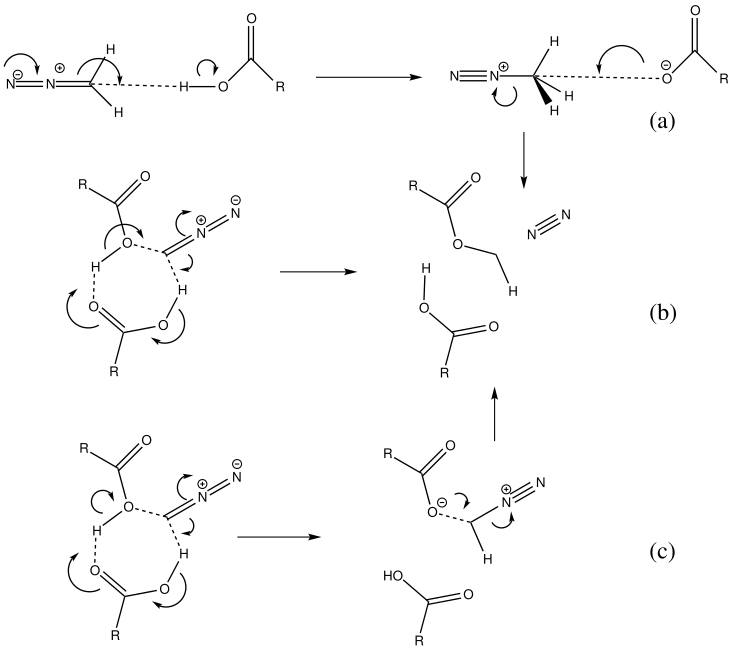
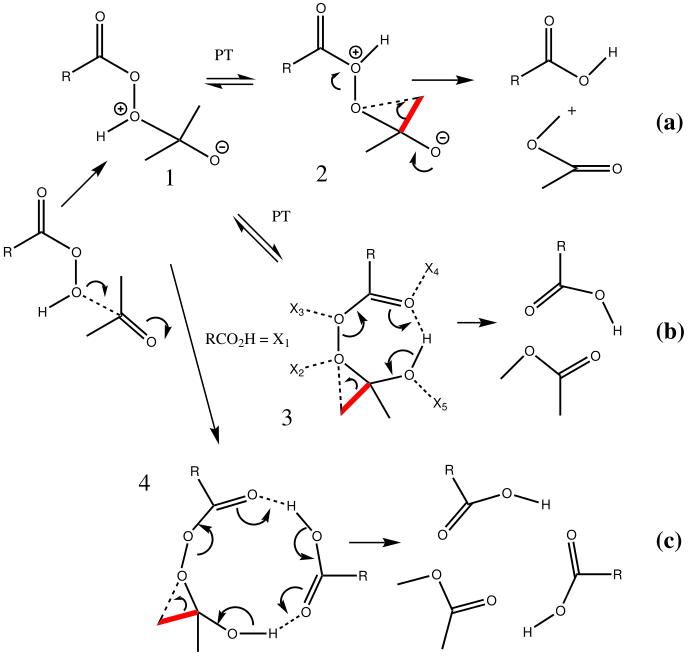
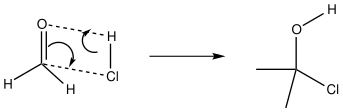
Many reaction mechanisms involve a combination of bond formation/cleavage between two non-hydrogen atoms and those involving reorganisation of proximate hydrogens. The Baeyer-Villiger discussed previously illustrated a complex dance between the two types. Here I take a look at another such mechanism, the methylation of a carboxylic acid by diazomethane.

Reaction MechanismFinal ProductFree EnergyHistoricalStereoelectronicChemieEnglisch
Veröffentlicht

The Baeyer-Villiger rearrangement was named after its discoverers, who in 1899 described the transformation of menthone into the corresponding lactone using Caro’s acid (peroxysulfuric acid). The mechanism is described in all text books of organic chemistry as involving an alkyl migration.

Chemical ITInteresting ChemistryComputational ChemistComputational ChemistryHistoricalChemieEnglisch
Veröffentlicht

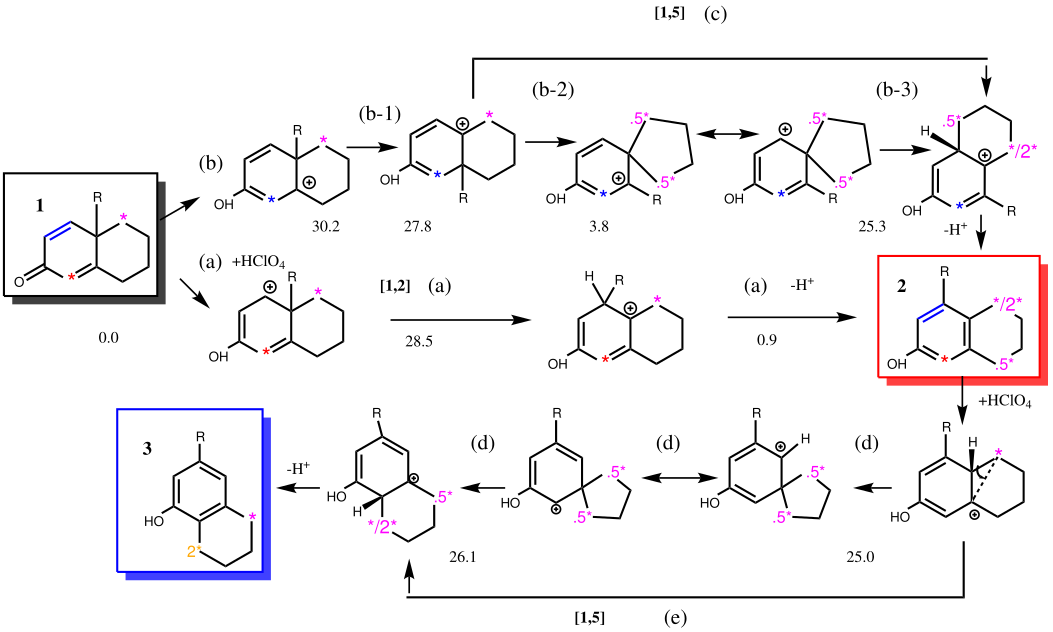
During the 1960s, a holy grail of synthetic chemists was to devise an efficient route to steroids. R. B. Woodward was one the chemists who undertook this challenge, starting from compounds known as dienones (e.g. 1) and their mysterious conversion to phenols (e.g. 2 or 3) under acidic conditions.

Interesting ChemistryCatalysisCondensationEnergyGas-phase Optimised GeometryChemieEnglisch
Veröffentlicht

Astronomers who discover an asteroid get to name it, mathematicians have theorems named after them. Synthetic chemists get to name molecules (Hector’s base and Meldrum’s acid spring to mind) and reactions between them. What do computational chemists get to name? Transition states! One of the most famous of recent years is the Houk-List.

Interesting ChemistryAlkaline Sodium Hypobromite SolutionChemical SynthesisHistoricalMetal CatalysisChemieEnglisch
Veröffentlicht

Chemists love a mystery as much as anyone. And gaps in patterns can be mysterious. Mendeleev’s period table had famous gaps which led to new discovery. And so from the 1890s onwards, chemists searched for the perbromate anion, BrO4–. It represented a gap between perchlorate and periodate, both of which had long been known.

ChiropticsHistoricalDichloropropaneEpoxybuteneGas PhaseChemieEnglisch
Veröffentlicht

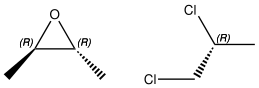
I mentioned in my last post an unjustly neglected paper from that golden age of 1951-1953 by Kirkwood and co. They had shown that Fischer’s famous guess for the absolute configurations of organic chiral molecules was correct. The two molecules used to infer this are shown below.

ChiropticsHistoricalCaliforniaChiroptical SpectroscopiesComputational ChemistryChemieEnglisch
Veröffentlicht

I wrote in an earlier post how Pauling’s Nobel prize-winning suggestion in February 1951 of a (left-handed) α-helical structure for proteins was based on the wrong absolute configuration of the amino acids (hence his helix should really have been the right-handed enantiomer). This was most famously established a few months later by Bijvoet’s definitive crystallographic determination of the […]