The year is 1959. Eisenhower is on his second term, Castro just kicked Batista out of the country and Ray Charles’s Let the Good Times Roll is topping the charts.

The year is 1959. Eisenhower is on his second term, Castro just kicked Batista out of the country and Ray Charles’s Let the Good Times Roll is topping the charts.

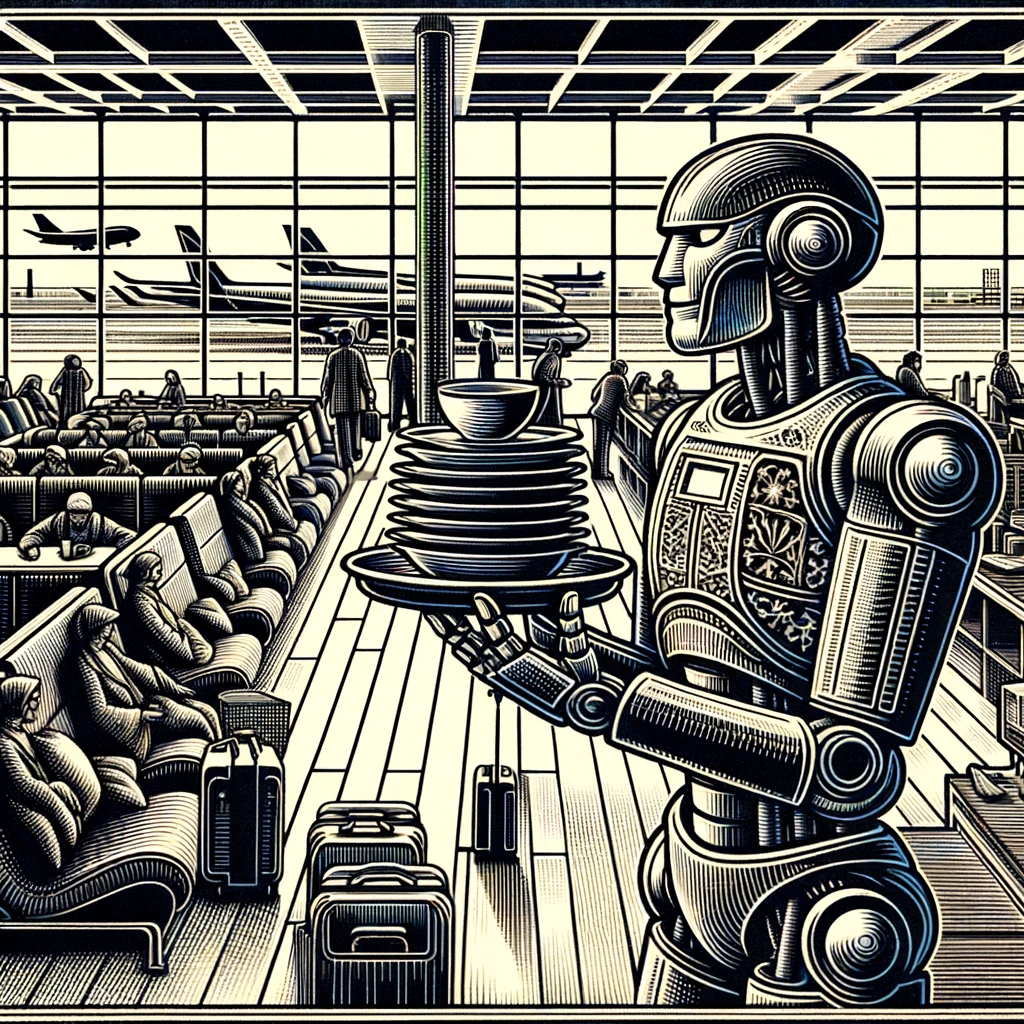
Say you’re busing tables and you’re trying to pass someone in a wheelchair. What do you do? Do you say “excuse me” and wait for them to move? Do you say “excuse me” and then try to pass them? Do you just try to pass them? Do you say nothing and just try to pass them? All of these are, actually, pretty legitimate answers. Now, say you’re a robot.

It’s not every day that you find out you have climbed the exalted heights of another discipline. My work is pretty interdisciplinary, but it shocked me, too, that I’m apparently holding forth on neoliberalism and the epistemic question in African universities (archive link): This, of course, came at some surprise to me, as I have never written anything on the topic.

I love posts that allow me to merge some of my addictions.

It appears that in what is clearly a wonderful little PR stunt, a Polish rum company managed to do a Sophia and appoint an ‘AI-driven’ ‘robot’ as its ‘CEO’. The other guilty party to this pile of steaming bovine excrement is Hanson Robotics, famous for giving us Sophia, the “world’s first robot citizen”. Most of what I’m saying here goes just as well for Sophia.

In the first four entries (1 2 3 4) of this sequence, I have focused primarily on what LLMs aren’t, can’t, won’t, wouldn’t and shouldn’t. It’s probably time to conclude this series by that much awaited moment in all stories, where the darkest night finally turns into a glorious dawn, where we finally arrive at the promised land, where we finally get to talk about what LLMs could be. What I see as the most successful potential model of

There’s a style of visual design I’m inordinately fond of called Raygun Gothic. It’s hard to describe what the hell exactly one needs to be on to enjoy it, but think of it like the aesthetic from the latter Fallout games with a more optimistic outlook on the future. Gibson described it as “the future that never was”, and I think that’s a pretty apt description. We get these competing futures in technology all the time.

The temple of Asclepios, the Greek god of healing arts and medicine, at Epidaurus was pretty much the ancient Greek world’s equivalent of the Mayo Clinic. It then tells us a lot about the Greek worldview of healing that one of the things the temple complex prominently featured was a theatre. The Greeks believed in drama therapy, but in perhaps a slightly different way of how we think of it today.
Tip If you’re here for the DOI matching script, the link is here. Quarto is a great tool for reproducible research. It is also a great tool for building websites. After about a decade of Wordpress-based websites, I’ve moved to Quarto primarily for two reasons. First, most of my content is largely static.

I have probably spent more time looking at Poussin’s Dance to the Music of Time than any other work of art. Sneaking off to the Wallace Collection in London and just looking at the Dance was my comfort activity while living in London – a time that was not exactly devoid of its trials. It’s not, by any measure, great art, insofar as such judgments can be made with any objectivity.
There’s something special about language. It is ‘our own’, it is ‘us’, in a profound way, and quite surprisingly, more so than art. I was deeply struck by this when I first saw reactions to large generative language models that created realistic, human-ish prose.