QuímicaInglêsWordPress

Henry Rzepa's Blog

Henry Rzepa's Blog
Chemistry with a twist
Pagina inicialFeed Atom
language
Chemical ITAppleBBCDigital PhotographyEngineerQuímicaInglês
Publicados

A few years ago, we published an article which drew a formal analogy between chemistry and iTunes (sic). iTunes was the first really large commercial digital music library, and a feature under-the-skin was the use of meta-data to aid discoverability of any of the 10 million (26M in 2013) or so individual items in the store.‡ […]

Low EnergyLow Free-energy BarrierReaction MechanismTutorial MaterialQuímicaInglês
Publicados

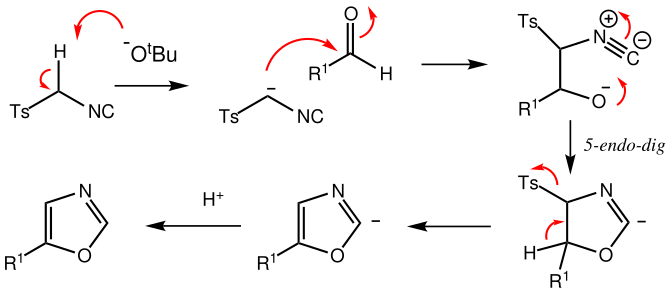
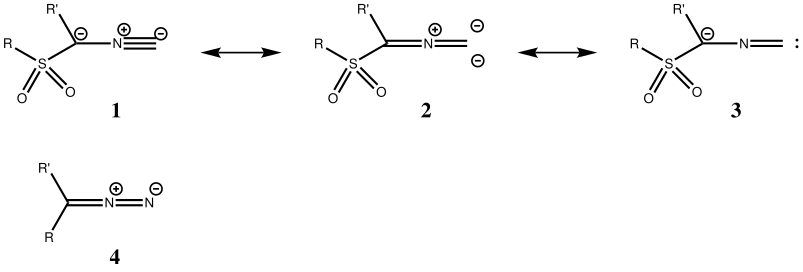
This is a follow-up to comment posted by Ryan, who asked about isocyanide’s role (in the form of the anion of tosyl isocyanide, or TosMIC): “In Van Leusen, it (the isocyanide) acts as an electrophile”. The Wikipedia article (recently updated by myself) shows nucleophilic attack by an oxy-anion on the carbon of the C≡N group, […]

PericyclicElectrocyclicEnergyFinal ProductFree EnergyQuímicaInglês
Publicados

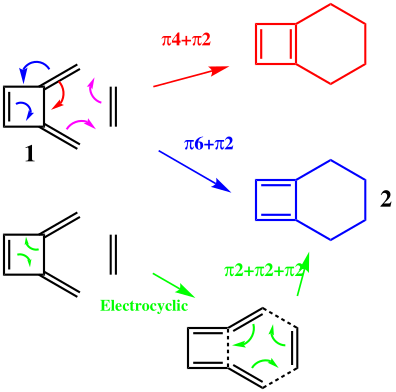
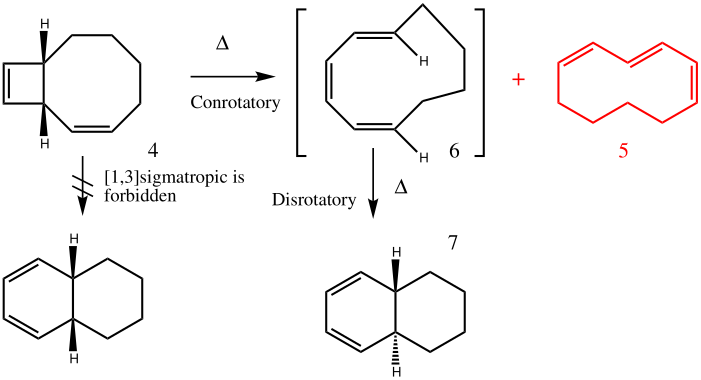
Sometimes the originators of seminal theories in chemistry write a personal and anecdotal account of their work. Niels Bohr was one such and four decades later Robert Woodward wrote “The conservation of orbital symmetry” (Chem. Soc. Special Publications (Aromaticity), 1967, 21, 217-249;

HypervalencyInteresting ChemistryAfrican UnionAlkene-metal CompoundsEmpty Metal OrbitalQuímicaInglês
Publicados

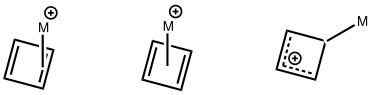
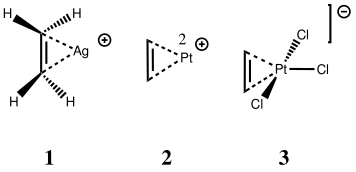
In the preceding post, I introduced Dewar’s π-complex theory for alkene-metal compounds, outlining the molecular orbital analysis he presented, in which the filled π-MO of the alkene donates into a Ag+ empty metal orbital and back-donation occurs from a filled metal orbital into the alkene π* MO. Here I play a little “what if” game with this […]

Interesting ChemistryReaction MechanismQuímicaInglês
Publicados

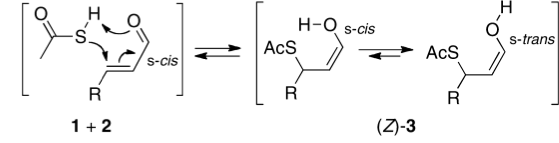
Lukas, who occasionally comments on this blog, sent me the following challenge. In a recent article he had proposed that the stereochemical outcome (Z) of reaction between a butenal and thioacetic acid as shown below arose by an unusual concerted cycloaddtion involving an S-H bond.

Interesting ChemistryCF 3 COFree EnergyGood Model For The Subsequent Transition StateLower Free Energy BarrierQuímicaInglês
Publicados

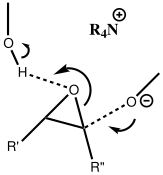
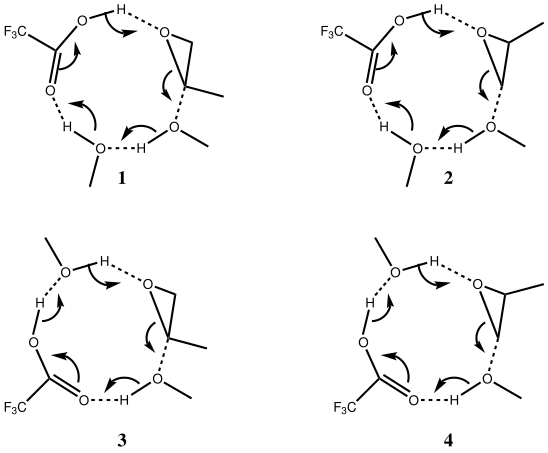
In a previous post on the topic, I remarked how the regiospecific ethanolysis of propene epoxide could be quickly and simply rationalised by inspecting the localized NBO orbital calculated for either the neutral or the protonated epoxide.