Bilgisayar ve Bilişim BilimleriİngilizceHugo

Crossref Blog

Crossref Blog
Recent content in Blog on Crossref
Ana SayfaAtom Besleme
language
CrossrefMetadataORCIDResearch NexusBilgisayar ve Bilişim Bilimleriİngilizce
Yayınlandı

In the next few weeks, authors with an ORCID iD will be able to have Crossref automatically push information about their published work to their ORCID record. It’s something that ORCID users have been asking for and we’re pleased to be the first to develop the integration.
CollaborationCrossrefDataEvent DataIdentifiersBilgisayar ve Bilişim Bilimleriİngilizce
Yayınlandı

Publishers, researchers, funders, institutions and technology providers are all interested in better understanding how scholarly research is used. Scholarly content has always been discussed by scholars outside the formal literature and by others beyond the academic community. We need a way to monitor and distribute this valuable information.

CrossmarkCrossrefMetadataOpen Funder RegistryBilgisayar ve Bilişim Bilimleriİngilizce
Yayınlandı

Crossref’s funding data initiative (FundRef) encourages publishers to deposit information about the funding sources of authors’ research as acknowledged in their papers. The funding data comprises funder name and identifier, and grant number or numbers.

CrossrefIdentifiersProgrammingBilgisayar ve Bilişim Bilimleriİngilizce
Yayınlandı

We regularly see developers using regular expressions to validate or scrape for DOIs. For modern Crossref DOIs the regular expression is short /^10.\d{4,9}/[-._;()/:A-Z0-9]+$/i For the 74.9M DOIs we have seen this matches 74.4M of them. If you need to use only one pattern then use this one.

CrossrefWikipediaBilgisayar ve Bilişim Bilimleriİngilizce
Yayınlandı
Yazar Joe Wass

We’ve been collecting citation events from Wikipedia for some time. We’re now pleased to announce a live stream of citations, as they happen, when they happen. Project this on your wall and watch live DOI citations as people edit Wikipedia, round the world.

CrossrefDataCiteDOIsHandleIdentifiersBilgisayar ve Bilişim Bilimleriİngilizce
Yayınlandı

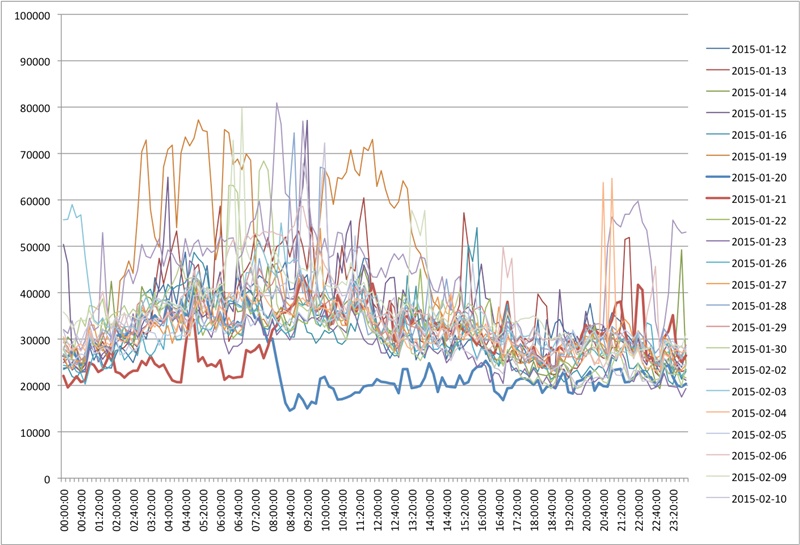
Background On January 20th, 2015 the main DOI HTTP proxy at doi.org experienced a partial, rolling global outage. The system was never completely down, but for at least part of the subsequent 48 hours, up to 50% of DOI resolution traffic was effectively broken.

CitationCitation FormatsCrossrefEvent DataLinkingBilgisayar ve Bilişim Bilimleriİngilizce
Yayınlandı
Yazar Joe Wass

TL;DR Watch a real-time stream of DOIs being cited (and “un-cited!” ) in Wikipedia articles across the world: https://live.eventdata.crossref.org/live.html Background For years we’ve known that the Wikipedia was a major referrer of Crossref DOIs and about a year ago we confirmed that, in fact, the Wikipedia is the 8th largest refer

CitationCrossrefEvent DataIdentifiersLinkingBilgisayar ve Bilişim Bilimleriİngilizce
Yayınlandı

TL;DR Crossref’s “DOI Event Tracker Pilot”- 11 million+ DOIs & 64 million+ events. You can play with it at: http://goo.gl/OxImJa Tracking DOI Events So have you been wondering what we’ve been doing since we posted about the experiments we were conducting using PLOS’s open source ALM code?

CrossrefDataCiteHandleIdentifiersPersistenceBilgisayar ve Bilişim Bilimleriİngilizce
Yayınlandı

Hell’s teeth. So today (January 20th, 2015) the DOI HTTP resolver at dx.doi.org started to fail intermittently around the world. The doi.org domain is managed by CNRI on behalf of the International DOI Foundation. This means that the problem affected all DOI registration agencies including Crossref, DataCite, mEDRA etc.