Kimya BilimleriİngilizceWordPress

Henry Rzepa's Blog

Henry Rzepa's Blog
Chemistry with a twist
Ana SayfaAtom Besleme
language
Interesting ChemistryImmediate ProductInversionReaction MechanismTriflate LeavingKimya Bilimleriİngilizce
Yayınlandı

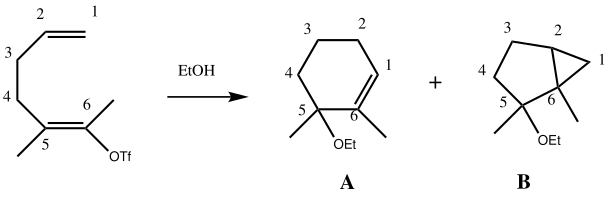
The reaction described in the previous post (below) is an unusual example of nucleophilic attack at an sp2-carbon centre, reportedly resulting in inversion of configuration. One can break it down to a sequence of up to eight individual steps, which makes teaching it far easier. But how real is that sequence?
Chemical KnowledgeReaction MechanismResearcherTutorial MaterialKimya Bilimleriİngilizce
Yayınlandı

The reaction below plays a special role in my career. As a newly appointed researcher (way back now), I was asked to take tutorial groups for organic chemistry as part of my duties. I sat down to devise a suitable challenge for the group, and came upon the following reaction.

Interesting ChemistryIron ComplexMetalPostscriptKimya Bilimleriİngilizce
Yayınlandı

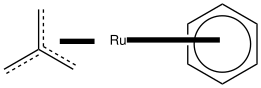
Every once in a while, one encounters a molecule which instantly makes an interesting point. Thus Ruthenium is ten electrons short of completing an 18-electron shell, and it can form a complex with benzene on one face and a ligand known as trimethylenemethane on the other.

Interesting ChemistryEnergyFairly Simple Model For The Reaction Between Bromine And EtheneIonic SystemsKcal/mol MORE StableKimya Bilimleriİngilizce
Yayınlandı

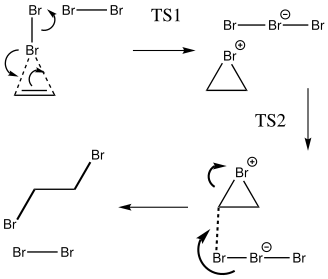
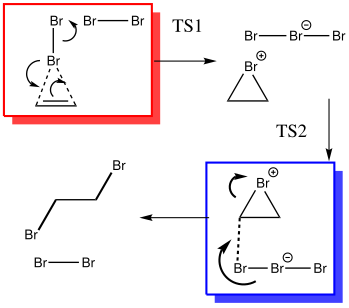
There is often a disconnect between how a text-book (schematically) represents a reaction and a more quantitive “reality” revealed by quantum mechanics. Is the bromination of ethene to give 1,2-dibromoethane one such example?

Interesting ChemistryReaction MechanismX-rayKimya Bilimleriİngilizce
Yayınlandı

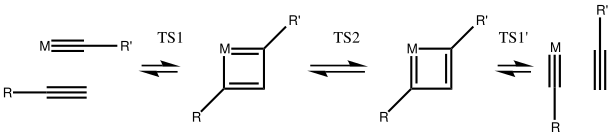
Metathesis reactions are a series of catalysed transformations which transpose the atoms in alkenes or alkynes. Alkyne metathesis is closely related to the same reaction for alkenes, and one catalyst that is specific to alkynes was introduced by Schrock (who with Grubbs won the Nobel prize for these discoveries) and is based on tungsten (M=W(OR)3).

Interesting ChemistryFree Ligand SiteMetalMetal CoordinationReaction MechanismKimya Bilimleriİngilizce
Yayınlandı

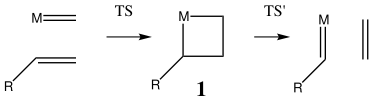
Alkene metathesis is part of a new generation of synthetic reaction in which a double C=C bond is formed from appropriate reactants where no bond initially exists (another example is the Wittig reaction), with the involvement† of a 4-membered-ring metallacyclobutane ring 1 (again, very similar to the Wittig). I thought it might make a good […]

Reaction MechanismTutorial MaterialKimya Bilimleriİngilizce
Yayınlandı

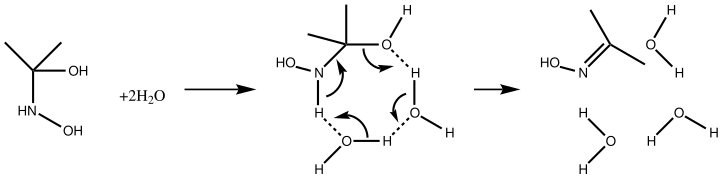
This is the follow-up to the previous post exploring a typical nucleophilic addition-elimination reaction. Here is the elimination step, which as before requires proton transfers. We again adopt a cyclic mechanism to try to avoid the build up of charge separation during those proton movements.

Interesting ChemistryReaction MechanismAnimationEnergy DifferenceFree EnergyKimya Bilimleriİngilizce
Yayınlandı

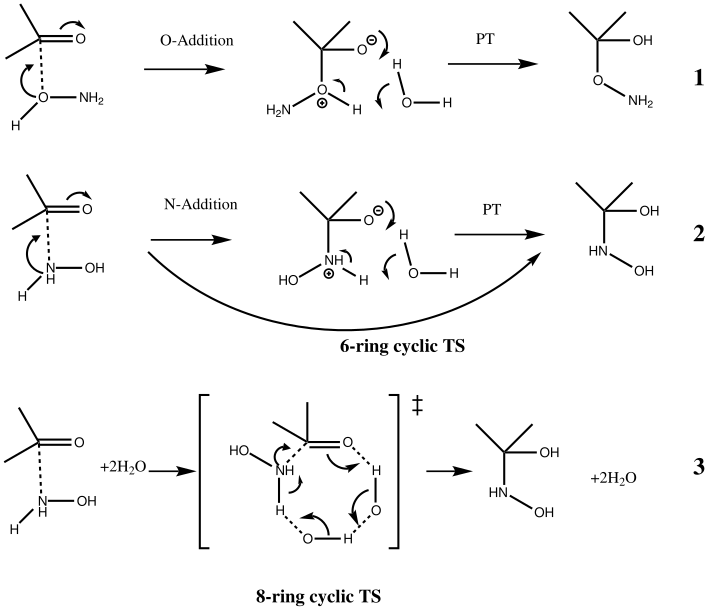
The mechanism of forming an oxime from nucleophilic addition of a hydroxylamine to a ketone is taught early on in most courses of organic chemistry. Here I subject the first step of this reaction to form a tetrahedral intermediate to quantum mechanical scrutiny.

Interesting ChemistryAromatic SystemsClarPericyclicReaction MechanismKimya Bilimleriİngilizce
Yayınlandı

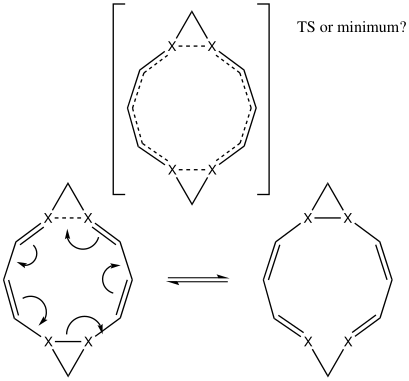
Semibullvalene is a molecule which undergoes a facile [3,3] sigmatropic shift. So facile that it appears this equilibrium can be frozen out at the transition state if suitable substituents are used. This is a six-electron process, which leads to one of those homologous questions; what happens with ten electrons?