Kimya BilimleriİngilizceWordPress

Henry Rzepa's Blog

Henry Rzepa's Blog
Chemistry with a twist
Ana SayfaAtom Besleme
language
ChiropticsHistoricalCaliforniaChiroptical SpectroscopiesComputational ChemistryKimya Bilimleriİngilizce
Yayınlandı

I wrote in an earlier post how Pauling’s Nobel prize-winning suggestion in February 1951 of a (left-handed) α-helical structure for proteins was based on the wrong absolute configuration of the amino acids (hence his helix should really have been the right-handed enantiomer). This was most famously established a few months later by Bijvoet’s definitive crystallographic determination of the […]
Interesting ChemistryFree EnergyLowest Energy GeometryO LpOxygen LpKimya Bilimleriİngilizce
Yayınlandı

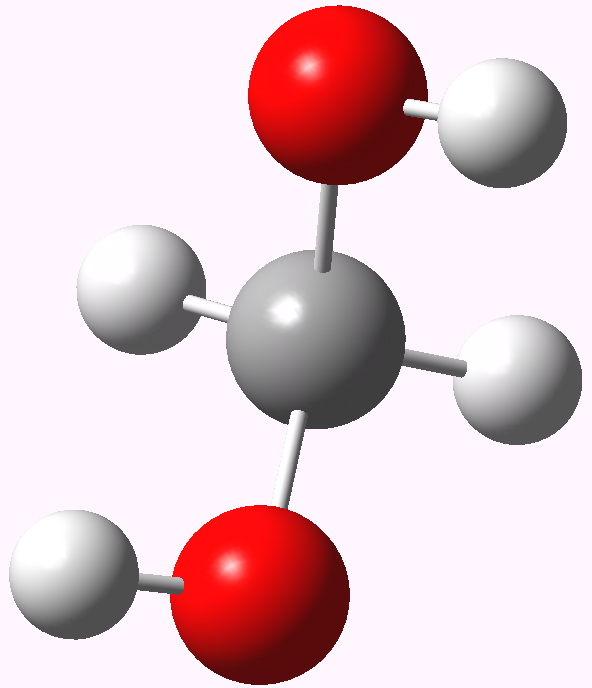
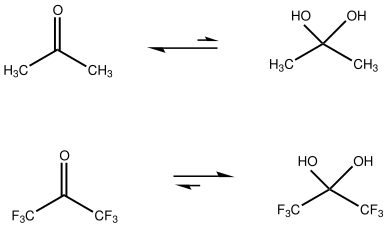
In my previous post I speculated why bis(trifluoromethyl) ketone tends to fully form a hydrate when dissolved in water, but acetone does not. Here I turn to asking why formaldehyde is also 80% converted to methanediol in water? Could it be that again, the diol is somehow preferentially stabilised compared to the carbonyl precursor and if so, why?

Chemical ITAPIChemical TermsChemical/science-savvy BlogChemical/scientificKimya Bilimleriİngilizce
Yayınlandı

Sometimes, as a break from describing chemistry, I take to describing the (chemical/scientific) creations behind the (WordPress) blog system. It is fascinating how there do seem increasing signs of convergence between the blog post and the journal article.

Tutorial MaterialKimya Bilimleriİngilizce
Yayınlandı

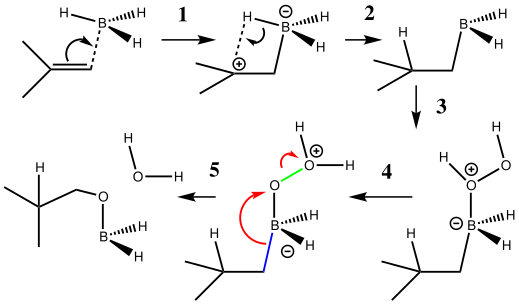
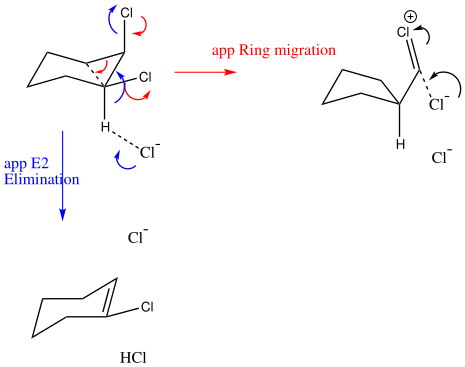
One thing almost always leads to another in chemistry. In the last post, I described how an antiperiplanar migration could compete with an antiperiplanar elimination. This leads to the hydroboration-oxidation mechanism, the discovery of which resulted in Herbert C. Brown (at least in part) being awarded the Nobel prize in 1979.

Interesting ChemistryConformational AnalysisTutorial MaterialKimya Bilimleriİngilizce
Yayınlandı

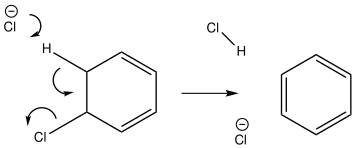
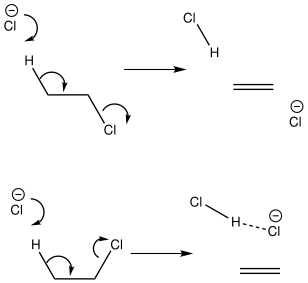
The so-called E2 elimination mechanism is another one of those mainstays of organic chemistry. It is important because it introduces the principle that anti-periplanarity of the reacting atoms is favoured over other orientations such as the syn-periplanar form; Barton used this principle to great effect in developing the theory of conformational analysis.

PericyclicTutorial MaterialKimya Bilimleriİngilizce
Yayınlandı

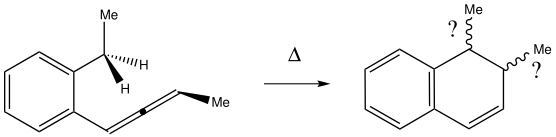
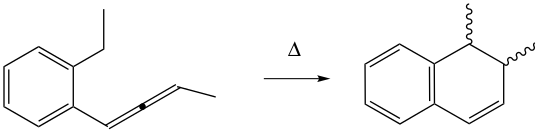
In the previous post, I went over how a reaction can be stripped down to basic components. That exercise was essentially a flat one in two dimensions, establishing only what connections between atoms are made or broken. Here we look at the three dimensional arrangements.

Chemical ReactionPericyclicReaction MechanismTutorial MaterialKimya Bilimleriİngilizce
Yayınlandı

Its a bit like a jigsaw puzzle in reverse, finding out to disassemble a chemical reaction into the pieces it is made from, and learning the rules that such reaction jigsaws follow. The following takes about 45-50 minutes to follow through with a group of students.

HypervalencyInteresting ChemistryNew ScientistNobel Gas ChemistryScientistKimya Bilimleriİngilizce
Yayınlandı

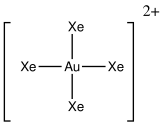
Chemistry rarely makes it to the cover of popular science magazines. Thus when this week, the New Scientist ran the headline “Forbidden chemistry. Reactions they said could never happen“, I was naturally intrigued. The examples included Woodward and Hoffmann’s “symmetry-forbidden” reactions, which have been the subject of several posts here already.