Kimya BilimleriİngilizceWordPress

Henry Rzepa's Blog

Henry Rzepa's Blog
Chemistry with a twist
Ana SayfaAtom Besleme
language
HypervalencyInteresting ChemistryNew ScientistNobel Gas ChemistryScientistKimya Bilimleriİngilizce
Yayınlandı

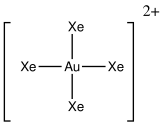
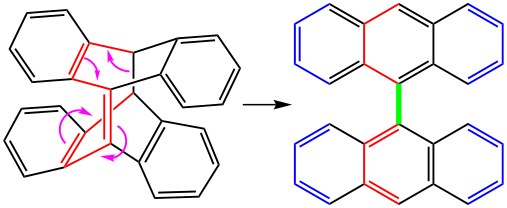
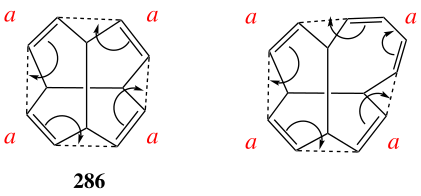
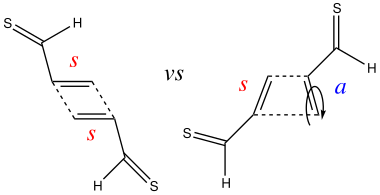
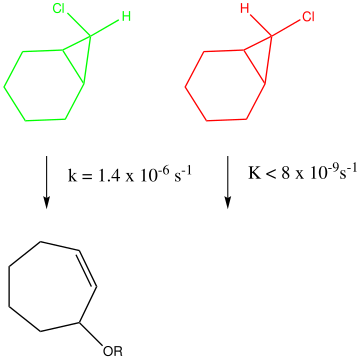
Chemistry rarely makes it to the cover of popular science magazines. Thus when this week, the New Scientist ran the headline “Forbidden chemistry. Reactions they said could never happen“, I was naturally intrigued. The examples included Woodward and Hoffmann’s “symmetry-forbidden” reactions, which have been the subject of several posts here already.
Interesting ChemistryReaction MechanismDiastereotopicSpectroscopyTetrahedral IntermediateKimya Bilimleriİngilizce
Yayınlandı

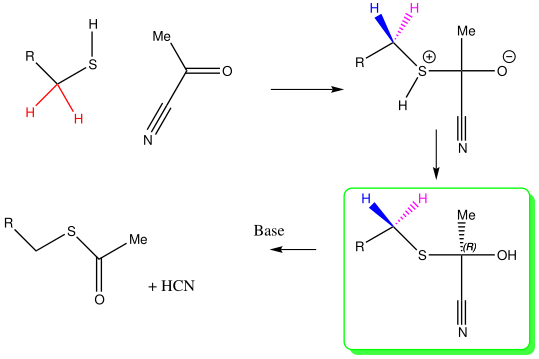
The tetrahedral intermediate is one of those iconic species on which the foundation of reaction mechanism in organic chemistry is built. It refers to a (normally undetected and hence merely inferred) species formed initially when a nucleophilic reagent attacks a carbonyl compound. Its importance to understanding the activity of enzymes cannot be overstated.

Interesting ChemistryPericyclicKimya Bilimleriİngilizce
Yayınlandı

A feature of many a classic review article is that not only does it organise and rationalise existing literature, but it will predict new chemistry as well. I have already noted Woodward and Hoffmann’s (WH) review as achieving the former, and here I take a (sideways) look at one of their predictions.

Interesting ChemistryPericyclicTutorial MaterialKimya Bilimleriİngilizce
Yayınlandı

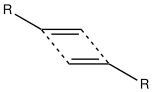
The previous post showed how the 2+2 cycloaddition of an alkene could occur by a sort of sideways insinuation of the bonds. I have also shown how the same reaction can occur with a dramatic rotation of one of the double bonds. This post compares the two moves side by side.

Interesting ChemistryAnimationPericyclicTutorial MaterialKimya Bilimleriİngilizce
Yayınlandı

In this earlier post, I described how the stereochemistry of π 2 2 cycloadditions occurs suprafacially if induced by light, and how one antarafacial component appears if the reaction is induced by heat alone. I also noted how Woodward and Hoffmann (WH) explained that violations to their rules were avoided by mandating a change in mechanism requiring stepwise pathways with intermediates along the route.

Chemical IT13-olide3-dien-6Eudesma-1Semantic WebKimya Bilimleriİngilizce
Yayınlandı

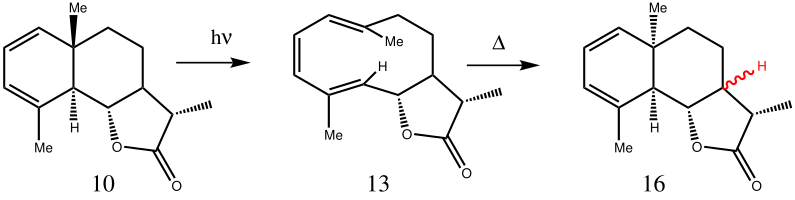
Previously, I had noted that Corey reported in 1963/65 the total synthesis of the sesquiterpene dihydrocostunolide. Compound 16, known as Eudesma-1,3-dien-6,13-olide was represented as shown below in black; the hydrogen shown in red was implicit in Corey’s representation, as was its stereochemistry. As of this instant, this compound is just one of 64,688,893 molecules recorded by Chemical Abstracts.