A couple of months ago, Ludo Waltman and André Brasil raised some questions about good practices for Crossref DOI registration, asking for input from the scholarly communication community.

A couple of months ago, Ludo Waltman and André Brasil raised some questions about good practices for Crossref DOI registration, asking for input from the scholarly communication community.

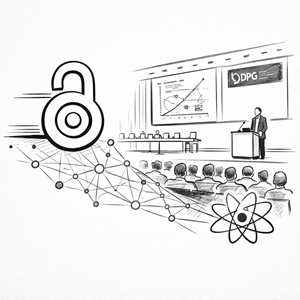
read this article in English Am 24. und 25. September 2025 fand der 7. VIVO-Workshop 2025 im Vortragsraum der TIB statt. An zwei Tagen gab es zahlreiche Vorträge und Diskussionen rund um das Open-Source-Forschungsinformationssystem VIVO, um (offene) Forschungsinformationen und alles, was die Community in diesem Umfeld bewegt.

Ce billet est la traduction du billet du blog officiel de Zotero annonçant la publication de la version 8 de Zotero.

What's "tacit knowledge" in biosecurity, and is it really a barrier? A look at the 2025 RAND paper "Contemporary Foundation AI Models Increase Biological Weapons Risk." 1.7k words, 8 min reading time.

Way back in 2010, when I was young and stupid, I wrote as follows in my History Of Sauropod Studies book-chapter (Taylor 2010:368–370): Ballou (1897) included, as one of his six figures, the first published life restoration of a sauropod, executed by Knight under the direction of Cope (Fig.

Es ist erstaunlich, wie schnell die Zeit vergeht – seit der Veröffentlichung der neuesten DINI-Thesen sind fast anderthalb Jahre vergangen. Vieles hat sich seitdem verändert und weiterentwickelt. In diesem Blogbeitrag werfen wir einen Blick zurück, aber noch wichtiger, wir schauen nach vorne. Wir initiieren eine Beitragsreihe, die sich mit den verschiedenen thematischen Thesen-Bereichen auseinandersetzen wird.

Mauricio Marchionni Urzay DR © Obra de bajorrelieve en telgopor (70 x 50 cm) Mendoza, Argentina. Junio de 2022 Redes del artista Instagram Esta es una reproducción digital, con fines de divulgación, de una obra original, todos los derechos de autor y reproducción están reservados por el artista.

One of the great privileges of astronomy is that there’s always something new and surprising to discover. It’s a big universe. There’s a lot in it. In appreciation of this simple joy, I thought I’d share a nifty discovery made by the Rubin Observatory*. This is a big ground-based telescope with an absolutely mammoth camera that is conducting a decade-long survey to unprecedented depth. It basically images the sky over and over again every night.
Since helping with the OxCaml tutorial last year at ICFP, I've been chomping at the bit to use it for real in our research infrastructure for planetary computing to manage the petabytes of TESSERA embeddings we've been generating. The reason for my eagerness is that OxCaml has a number of language extensions that give giant leaps in performance for systems-oriented programs, while retaining the familiar OCaml functional style of programming.

AI search tools aren't "agreeing" with users—they are retrieval systems. Confusing the two is a category error that obscures the real risks.
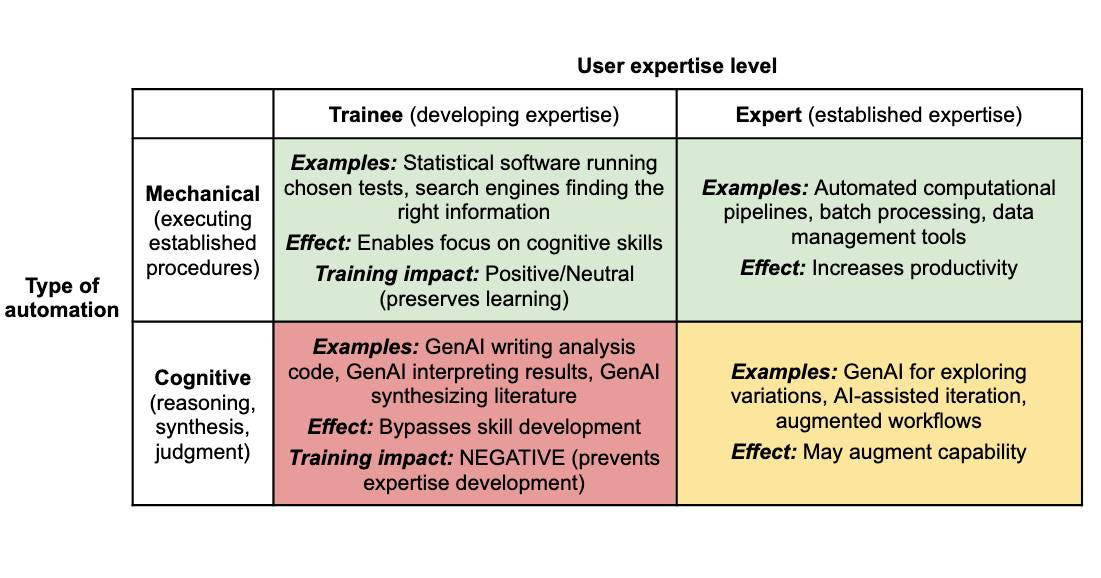
A preprint reporting results from an experiment conducted by Anthropic on the impact of AI assistance on coding skills is making the rounds. The Anthropic website writes: “participants in the AI group finished about two minutes faster, although the difference was not statistically significant.