BiologíaInglésWordPress

bjoern.brembs.blog

The blog of neurobiologist Björn Brembs
Página de inicioFeed Atom
language
Science PoliticsPublishingReliabilityRetractionsInglés
Publicado

Retractions of scholarly articles are a rare event, affecting only about 0.02-0.04% of articles in total (but yearly rates are going up dramatically). This means that data about retractions are not even close to being representative of the scholarly literature […] ↓ Read the rest of this entry...
Science PoliticsInfrastructureOpen Research EuropeOpen SciencePublishingInglés
Publicado

How audit rules and public infrastructure could break science’s publishing monopolies. An English version of my post for the Verfassungsblog from December 19, 2025. Scientific journals that feel straight out of 1665, prices that could come from a MrBeast meet-and-greet, […] ↓ Read the rest of this entry...

Own DataaPKCFoxPMotor NeuronOperantInglés
Publicado

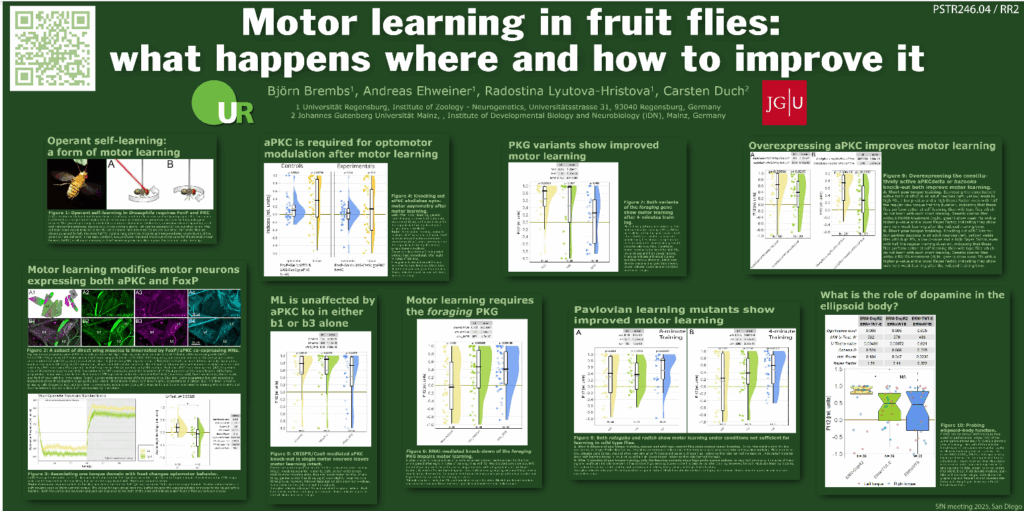
Due to political developments, the US have become a much less welcoming and hence dramatically less attractive place for academic conferences. This year, nobody from our research group was interested in attending our otherwise regular meeting of the Society for […] ↓ Read the rest of this entry...

Science PoliticsInfrastructureLibrariesLLMOpen ScienceBiologíaInglés
Publicado

I have been involved in the open science movement for nearly 20 years now. By now, it seems to me the problems have been clearly recognized and formulated, the experts agree on the necessary technical solutions (replacing the journals) and the funding is available.

ScienceDrosophilaHeisenbergOperantSpontaneityBiologíaInglés
Publicado

Ever since Werner Heisenberg formulated the uncertainty principle, physics has been grappling with the unsettling realization that the universe does not function like clockwork—a metaphor Newton introduced and which held sway for centuries.

NewsStudentsBiologíaInglés
Publicado

We are looking for two PhD students interested in the regulation of habit formation. Habits are useful to decrease cognitive load, but carry the risk of becoming stereotyped and hard to control – it’s hard to shake a bad habit.

Science PoliticsBlueskyMastodonSocial MediaBiologíaInglés
Publicado

Universities worldwide currently face a pivotal choice: should they contribute to building a global infrastructure for exchange, science, and discourse, free from the control of oligarchs, to promote democracy, human rights, and digital participation? Or should they continue advertising on private networks, hoping for clicks and marginally increased student enrollment?

Science PoliticsDFGGrantsJournal RankMetrricsBiologíaInglés
Publicado

For 14 years, the main research funding agency in Germany, the German Research Foundation (DFG) has stated in its guidelines that submitted grant proposals will be assessed primarily on the basis of their content , rather than counting the applicants’ previous publications. However, not all of DFG’s panels seem to be on board.

Own DataDrosophilaMotor LearningMotor NeuronOperantBiologíaInglés
Publicado

It has been almost 10 years now that we have come to the realization that a particular type of our operant experiments can be classified as motor learning. In such “operant self-learning” experiments, the animal learns about the consequences of its own behavior and adjusts future behavior accordingly.

ResearchbloggingAttentionChoiceDecision-makingBiologíaInglés
Publicado

In a discussion about what decisions are, John Krakauer emphatically pronounced that “decisions happen for reasons”, in answering ‘no’ to my question if it wasn’t a decision with which foot to start walking from a stand-still. A recent article from the laboratory of Carolina Rezaval in Birmingham studied a decision-making process in male Drosophila fruit flies where the reasons for each decision seemed apparent.

Own Data3aPKCFoxPMotor LearningBiologíaInglés
Publicado

I was very excited when our latest research paper came out, after all, I was confident our 30-year-long search for the sites of plasticity in the form of motor learning we study was coming to an end. In this work, we were fairly confident that underlying the type of learning we study was a novel form of plasticity in a very specific set of motor neurons in the ventral nerve cord of the flies we use for our research.