Ciencias QuímicasInglésSubstack

Corin Wagen

Corin Wagen
My personal blog, focusing on issues of chemistry and metascience, unified by trying to answer the question "how can we make science better"?
Página de inicioFeed RSS
language
Ciencias QuímicasInglés
Publicado

“Like arrows in the hand of a warrior are the children of one's youth.” –Psalm 127:4 What if our most fundamental assumptions about parenting were wrong? That’s the question that Michaeleen Doucleff’s 2021 book Hunt, Gather, Parent tries to tackle.

Ciencias QuímicasInglés
Publicado

(in the spirit of Dale Carnegie and post-rat etiquette guides) Scientists, engineers, and other technical people often make fun of networking. Until a few years ago, I did this too: I thought networking was some dumb activity done by business students who didn’t have actual work to do, or something exploitative focused on pure self-advancement.

Ciencias QuímicasInglés
Publicado

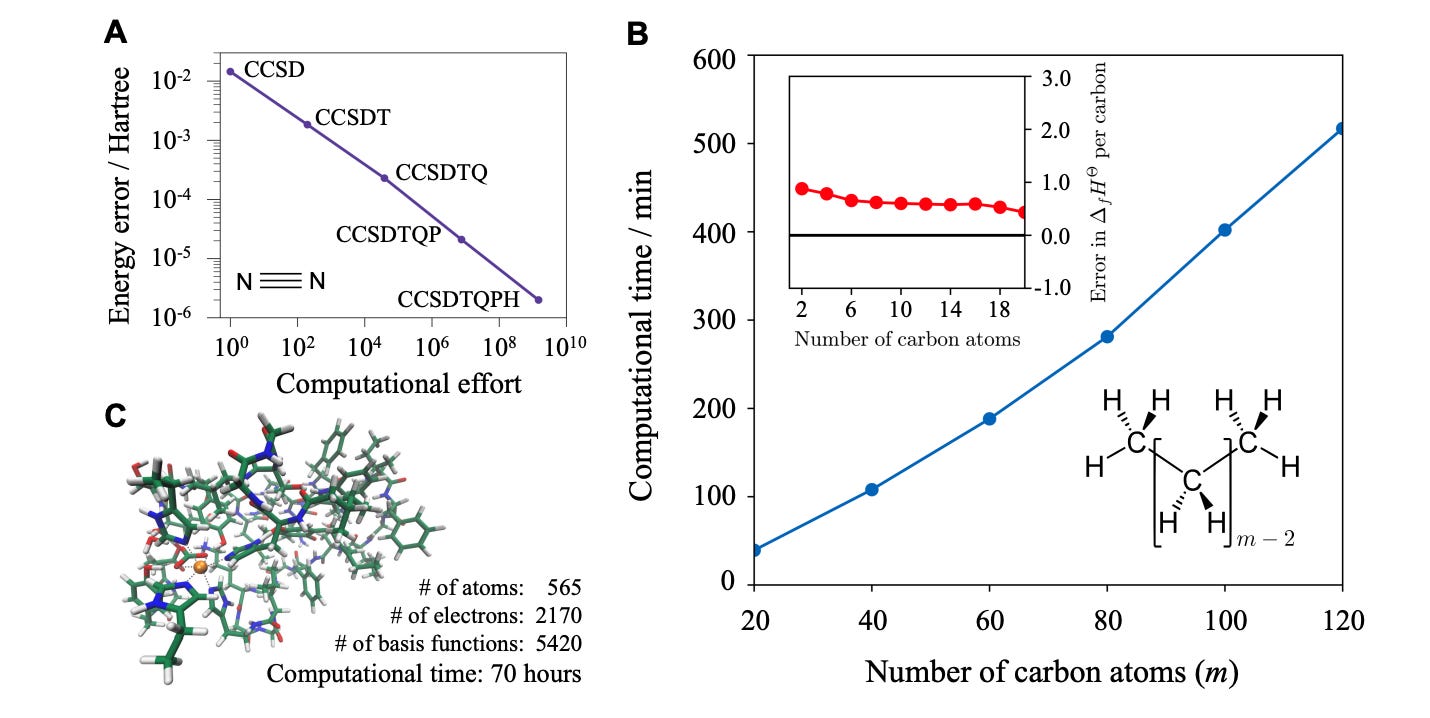
“A cord of three strands is not easily broken.” —Ecclesiastes 4:12 Computational chemistry, like all attempts to simulate reality, is defined by tradeoffs. Reality is far too complex to simulate perfectly, and so scientists have developed a plethora of approximations, each of which reduces both the cost (i.e. time) and the accuracy of the simulation.

Ciencias QuímicasInglés
Publicado

ICYMI: Ari and I announced our new company, Rowan! We wrote an article about what we're hoping to build, which you can read here. Also, this blog is now listed on The Rogue Scholar, meaning that posts have DOIs and can be easily cited. Conventional quantum chemical computations operate on a collection of atoms and create a single wavefunction for the entire system, with an associated energy and possibly other properties.

Ciencias QuímicasInglés
Publicado

The Pauling model for enzymatic catalysis states that enzymes are “antibodies for the transition state”—in other words, they preferentially bind to the transition state of a given reaction, rather than the reactants or products. This binding interaction stabilizes the TS, thus lowering its energy and accelerating the reaction.

Ciencias QuímicasInglés
Publicado

An important problem with simulating chemical reactions is that reactions generally take place in solvent, but most simulations are run without solvent molecules. This is a big deal, since much of the inaccuracy associated with simulation actually stems from poor treatment of solvation: when gas phase experimental data is compared to computations, the results are often quite good.

Ciencias QuímicasInglés
Publicado

TW: sarcasm. Today, most research is done by academic labs funded mainly by the government. Many articles have been written on the shortcomings with academic research: Sam Rodriques recently had a nice post about how academia is ultimately an educational institution, and how this limits the quality of academic research. (It’s worth a read;