Ciencias de la Tierra y Ciencias Ambientales relacionadasInglésSquarespace

Blog - Metadata Game Changers

Exploring metadata, communities, and new ideas.
Página de inicioFeed JSON
language
Ciencias de la Tierra y Ciencias Ambientales relacionadasInglés
Publicado

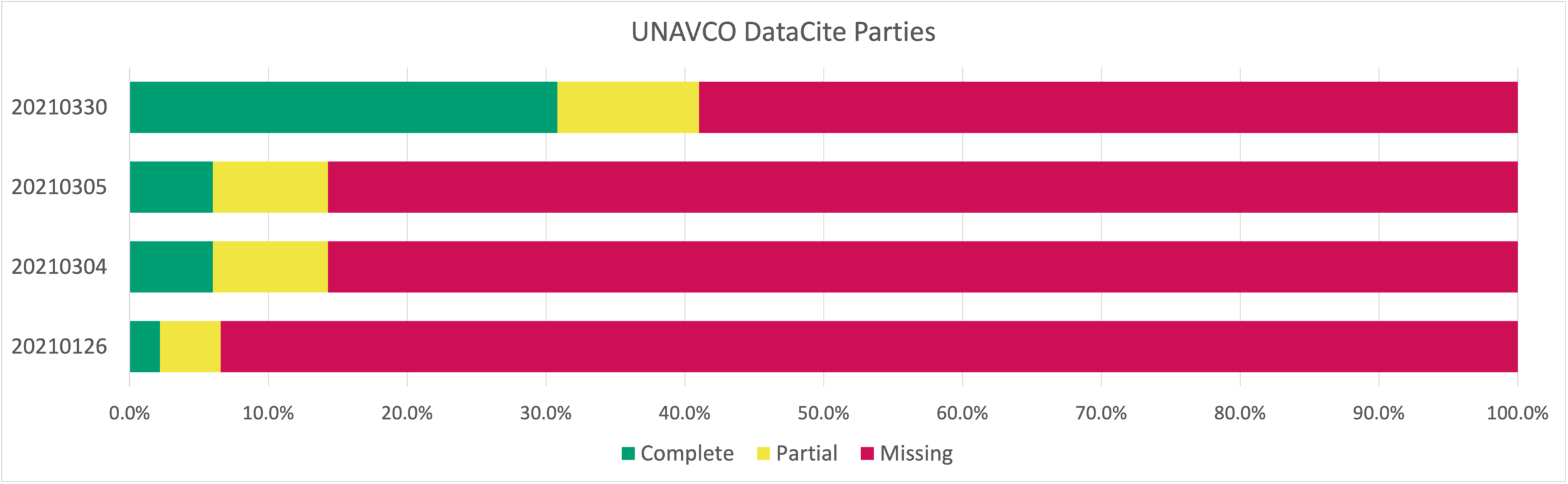
In previous blogs we used DataCite metadata for UNAVCO to demonstrate how identifiers could be found and spread through the metadata collection to improve connectivity for people and organizations. The community built around UNAVCO over time was a critical part of this process as community members, both individuals and organizations, make many contributions over time.

Ciencias de la Tierra y Ciencias Ambientales relacionadasInglés
Publicado

With Chris Beltz, S. Jeanette Clark, Peter Slaughter and Matt Jones from the Arctic Data Center ( https://ror.org/055hrh286 ) and NCEAS ( https://ror.org/0146z4r19 ). I have written several blogs about measuring metadata with goals of identifying good examples and quantifying improvements in metadata over time.

Ciencias de la Tierra y Ciencias Ambientales relacionadasInglés
Publicado

Most current metadata standards recognize that people and organizations play similar roles in the creation and management of datasets and other research objects. This dichotomy has been managed with the introduction of the concept of ‘party’ which, for example, could be a person, organization, or position in the ISO TC211 metadata standards for geographic data.

Ciencias de la Tierra y Ciencias Ambientales relacionadasInglés
Publicado

The UNAVCO DataCite Repository has over 5000 records that describe datasets created by researchers from many organizations, all of which are members of the tight-knit and well-established UNAVCO community. In the first blog of this series, I proposed that connecting these organizations to the PID Graph depends on having unique identifiers, i.e., RORs, for these organizations.

Ciencias de la Tierra y Ciencias Ambientales relacionadasInglés
Publicado

We just finished 24 hours of PIDapalooza  last week with talks and demos and an amazing amount of information presented by PID experts and users all over the world. It was a truly international meeting happening all over the world with presentations and discussions in many languages.

Ciencias de la Tierra y Ciencias Ambientales relacionadasInglés
Publicado

In honor of PIDapalooza 2021 and 25 hours of Persistent Identifier discussion happening today, we thought a post celebrating the power of PIDs for increasing connectivity and how to measure that connectivity is in order. Let’s party on 🥳 Discovery Before Conectivity (BC) : For many years we have thought about discovery in terms of web portals with text search boxes, maps, timelines, facets, or some other kind of interface.

Ciencias de la Tierra y Ciencias Ambientales relacionadasInglés
Publicado

Metadata schema evolution reflects the progression of needs, ideas, and practices of the community that creates and uses the metadata. Version 2.0 of the DataCite Metadata Schema was released ten years ago. During this time, the schema has evolved considerably, adding capabilities and supporting many new use cases.

Ciencias de la Tierra y Ciencias Ambientales relacionadasInglés
Publicado

The road to complete and consistent metadata can be long and arduous – digging through piles of metadata and other kinds of data to find small gems of information that can be added to metadata records, contacting recalcitrant researchers to fill in blanks, slowly building content across a collection… Does it really need to be that hard?

Ciencias de la Tierra y Ciencias Ambientales relacionadasInglés
Publicado

Looking for New Year’s metadata resolutions? How about: Stop using sentences that include the words “minimum metadata” without specifying a use case. Sentences that include the words “minimum metadata” come up frequently in metadata discussions, usually in the context of what a data provider wants to provide or, even more common, in the context of what should be expected of them.