Ciencias QuímicasInglésWordPress

Henry Rzepa's Blog

Henry Rzepa's Blog
Chemistry with a twist
Página de inicioFeed Atom
language
Interesting ChemistryActual Free Energy BarrierEnergyGas Phase ModelJulius SteglitzCiencias QuímicasInglés
Publicado

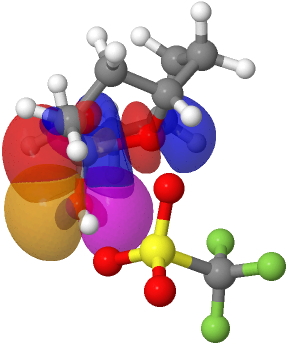
The ionization of a C-X bond (X=halogen) to form what we call a carbocation and which is known as the SN-1 reaction goes way back in the history of chemistry. Julius Steglitz was probably the first person to suggest such an ionization, back in 1899 (Steglitz, J.; Am. Chem.
Interesting ChemistryGas Phase ModelCiencias QuímicasInglés
Publicado

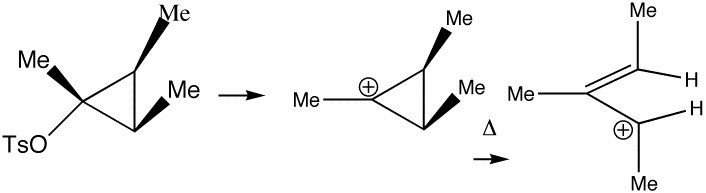
Click on diagram to see model. The reaction above is ostensibly a very simple pericyclic ring opening of a cyclopropyl carbocation to an allyl cation, preceeded by a preparatory step involving SN-1 solvolysis. As a 2-electron thermal process, the second step proceeds with disrotation of the terminii. Can this stereochemistry be illustrated with a computed model for the transition state for this process?

PericyclicHoffmannInteresting ChemistryJmolNICSCiencias QuímicasInglés
Publicado

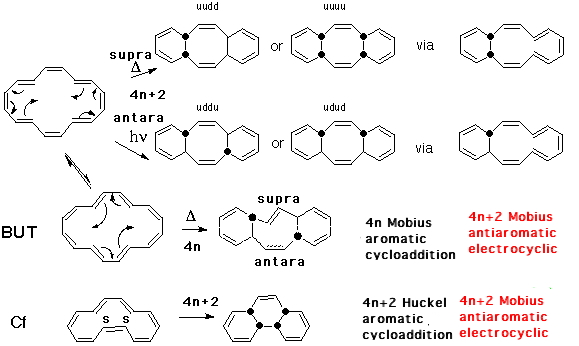
Mauksch and Tsogoeva have recently published an article illustrating how a thermal electrocyclic reaction can proceed with distoratory ring closure, whilst simultaneously also exhibiting 4n electron Möbius-aromatic character. Why is this remarkable? Because the simple Woodward-Hoffmann rules state that a disrotatory thermal electrocyclic reaction should proceed via a Hückel-aromatic 4n+2 electron transition state.