FísicaInglésWordPress.com

Triton Station

Triton Station
A Blog About the Science and Sociology of Cosmology and Dark Matter
Página de inicioFeed AtomMastodon
language
Dark MatterLaws Of NatureStellar PopulationsFísicaInglés
Publicado

Flat rotation curves and the Baryonic Tully-Fisher relation (BTFR) both follow from the Radial Acceleration Relation (RAR). In Mistele et al. (2024b) we emphasize the exciting aspects of the former; these follow from the RAR in the Mistele et al. (2024a). It is worth understanding the connection.

Dark MatterMONDRotation CurvesFísicaInglés
Publicado

Last time, we discussed the remarkable result that gravitational lensing extends the original remarkable result of flat rotation curves much farther out, as far as the data credibly probe. This corroborates and extends the result of Brouwer et al. They did a thorough job, but one thing they did not consider was Tully-Fisher.

Personal ExperienceFísicaInglés
Publicado

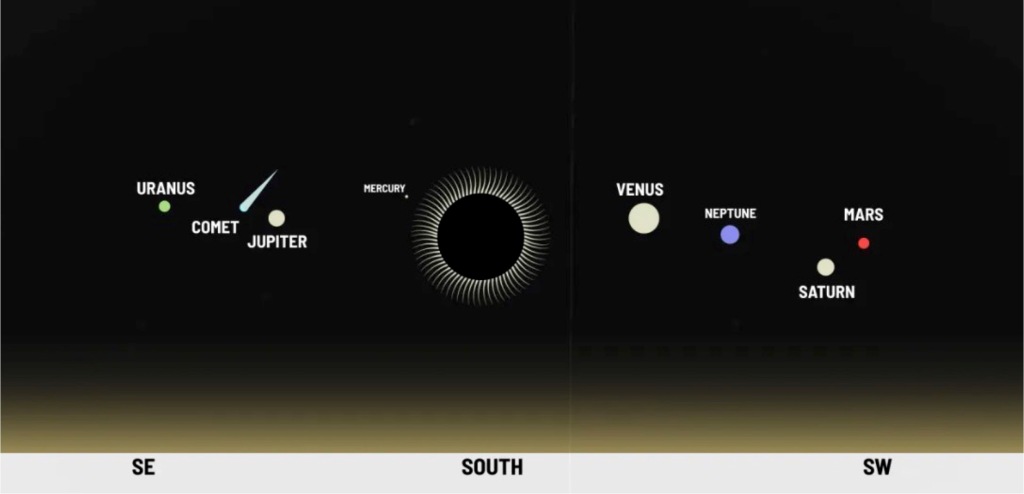
And pretty much everywhere else First, a pretty picture: The sun is nearing the peak of its eleven year sunspot cycle. That means lots of sunspots and associated activity. Solar prominences, visible to the naked eye during the eclipse, are bands of plasma entrained in the magnetic field connecting pairs of sunspots.

Personal ExperienceFísicaInglés
Publicado

We will return to our usual programming shortly. But first, a few words on the eclipse experience last Monday. It. Was. Awesome . That’s a few words, so Mission Accomplished. That’s really all I had planned to say. However, I find I am still giddy from this momentous event, so will share my experience of the day, such as words can humbly convey.

Personal ExperienceFísicaInglés
Publicado

Perhaps the most compelling astronomical phenomenon accessible to a naked-eye observer is a total eclipse of the sun. These rare events have always fascinated us, and often terrified us. It is abnormal and disturbing for the sun to be blotted from the sky! A solar eclipse will occur on Monday, 8 April 2024. A partial eclipse will be visible from nearly every part of North America.

Galaxy FormationJWSTLCDMMONDFísicaInglés
Publicado

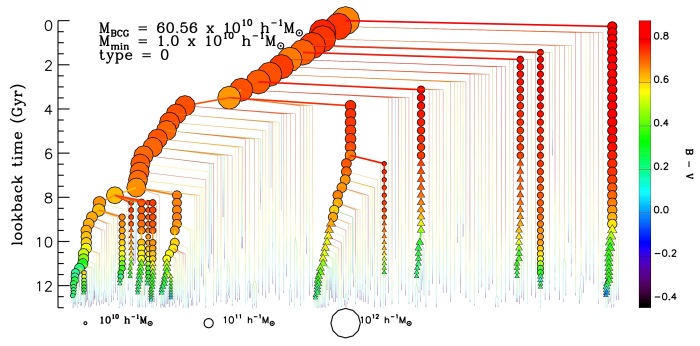
I just got back from a visit to the Carnegie Institution of Washington where I gave a talk and saw some old friends. I was a postdoc at the Department of Terrestrial Magnetism (DTM) in the ’90s. DTM is so-named because in their early days they literally traveled the world mapping the magnetic field. When I was there, DTM + had a small extragalactic astronomy group including Vera Rubin*, Francois Schweizer, and John Graham.

CosmologyGalaxy FormationJWSTLCDMMONDFísicaInglés
Publicado

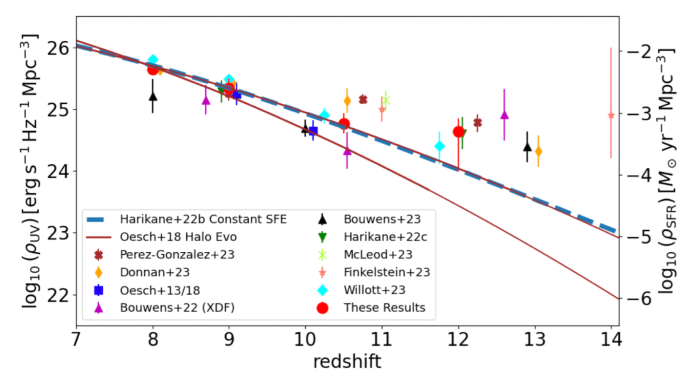
The results from the high redshift universe keep pouring in from JWST. It is a full time job, and then some, just to keep track. One intriguing aspect is the luminosity density of the universe at z > 10. I had not thought this to be problematic for LCDM, as it only depends on the overall number density of stars, not whether they’re in big or small galaxies. I checked this a couple of years ago, and it was fine.

Dark MatterData InterpretationLCDMMONDFísicaInglés
Publicado

A common refrain I hear is that MOND works well in galaxies, but not in clusters of galaxies. The oft-unspoken but absolutely intended implication is that we can therefore dismiss MOND and never speak of it again. That’s silly. Even if MOND is wrong, that it works as well as it does is surely telling us something.