Informatique et sciences de l'informationAnglaisGhost

Front Matter

Front Matter
The Front Matter Blog covers the intersection of science and technology since 2007.
Page d'accueilFlux AtomMastodonISSN 2749-9952
language
NewsInformatique et sciences de l'informationAnglais
Publié

We launched this blog six weeks ago on a hosted version of Ghost, the open source blogging platform. Ghost doesn't have all the features of Wordpress or other more mature blogging platforms, but it is a pleasure to use. The other alternative would have been to put the blog up on the Drupal-based main DataCite website, but Drupal is really a content-management system and usually not the best choice for a serious blog.

MetadataInformatique et sciences de l'informationAnglais
Publié

Last week Jennifer Lin shared information on the Making Data Count (MDC) project on this blog. MDC is a project funded by the U.S. National Science Foundation (NSF) to design and develop metrics that track and measure data use – data-level metrics (DLM). Funding for the 12 month project ends October 1st, with a no-cost extension until March 1st. MDC is a research project and has delivered some interesting questions and important results.

MetadataInformatique et sciences de l'informationAnglais
Publié

CSV (comma-separated values) is a popular file format for data. It is popular because it is very simple: CSV is text-based and any application that can open text files can read or write CSV. This makes it a good fit for digital preservation. We don't know how many of the datasets in DataCite use CSV because the format metadata attribute is not used much (this query gives you some examples), but we know that the number is big.

MetadataInformatique et sciences de l'informationAnglais
Publié

In the first post of this new blog a few weeks ago I talked about Data-Driven Development, and that service monitoring is an important aspect of this. The main service DataCite is providing is registration of digital object identifiers (DOIs) for scholarly content, in particular research data.

NewsInformatique et sciences de l'informationAnglais
Publié

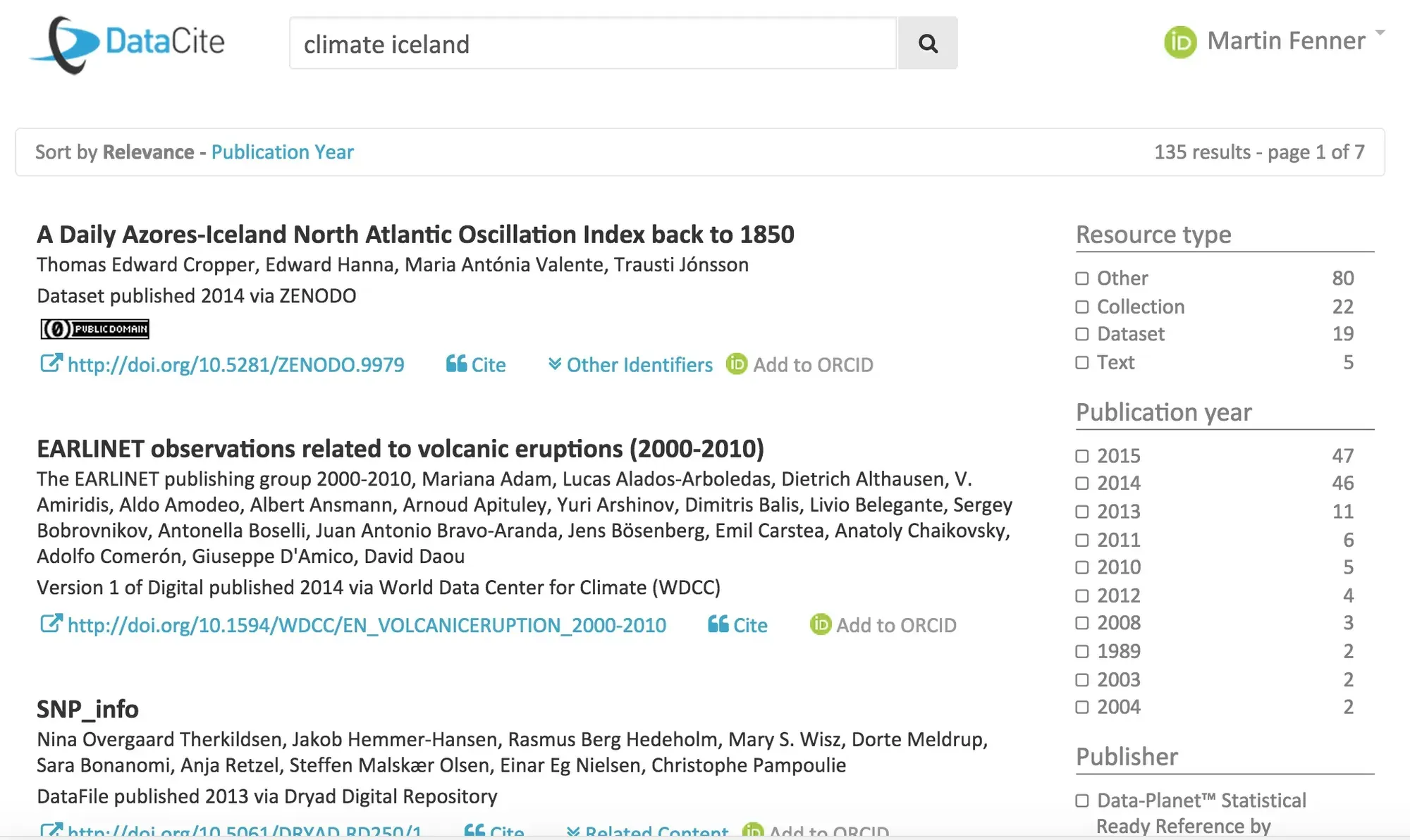
Today I am pleased to announce the launch of a new service, DataCite Labs Search – the service is available immediately at https://search.datacite.org/. This is one of THOR’s first services and is based on work in the earlier EC-funded ODIN Project. The ODIN project launched the DataCite/ORCID claiming tool in June 2013. The DataCite/ORCID claiming tool allows users to add works from the DataCite Metadata Store (MDS) to their ORCID profile.

FeatureInformatique et sciences de l'informationAnglais
Publié

Today DataCite received an email from a user alerting us that there are some small inconsistencies with our recommended data citation format: Creator (PublicationYear): Title. Publisher. Identifier at https://www.datacite.org/services/cite-your-data.html Creator; (PublicationYear): Title; Publisher.

FeatureInformatique et sciences de l'informationAnglais
Publié

This week I start as the new DataCite Technical Director. While I get up to speed with existing DataCite services and infrastructure, and we start to launch new services (e.g. this blog), this is also a good time to communicate the overall approach I am taking. I like to call it Data-Driven Development, or DDD as we all love acronyms.

NewsInformatique et sciences de l'informationAnglais
Publié

Starting next week I will work as the DataCite Technical Director, and I am excited about this new opportunity. But this is material for another post, here I want to reflect on the last three years working as Technical Lead for the PLOS Article-Level Metrics project.

MetadataInformatique et sciences de l'informationAnglais
Publié

Four years ago I wrote a blog post about component DOIs. It is time to revisit the topic, in particular since our approach to citing data associated with a publication has changed since 2011. Component DOIs are explained in the CrossRef Help System: DOIs may be assigned to items that are part of a journal article, book chapter, or any other content item.

FeatureInformatique et sciences de l'informationAnglais
Publié

Just like the rest of the internet, much of our scholarly infrastructure is built around the Hypertext Transfer Protocol (HTTP), increasingly HTTPS for security, and soon HTTP/2 for better performance. In this infrastructure Universal Resource Locators (URLs) are essential to locate resources (sic) such as scholarly articles, datasets, researchers, organizations, or grants.