Autres sciences socialesAnglaisSubstack

Aaron Tay's Musings about librarianship

Aaron Tay's thoughts about academic librarianship
Page d'accueilFlux Atom
language
Retrieval Augmented GenerationLarge Language ModelAi SearchAutres sciences socialesAnglais
Publié
Auteur Aaron Tay

My blog focuses on the two primary ways "AI"—or more accurately, transformer-based models—are impacting academic search. The first, and flashier application is in generating synthesized answers with citations from retrieved articles, a technique known as Retrieval Augmented Generation (RAG). The second, which is the focus of this post, involves the rise of non-lexical or keyword search methods.

Conferences Autres sciences socialesAnglais
Publié
Auteur Aaron Tay

Tired of the usual library and scholarly communication conferences in the US or Europe? You're in luck! In 2026, the Asia-Pacific region will host at least two top-class conferences (formerly hosted in US/Europe) that I highly recommend. Thanks for reading Aaron Tay's Musings about Librarianship!

Retrieval Augmented GenerationAi SearchRetractionsAutres sciences socialesAnglais
Publié
Auteur Aaron Tay

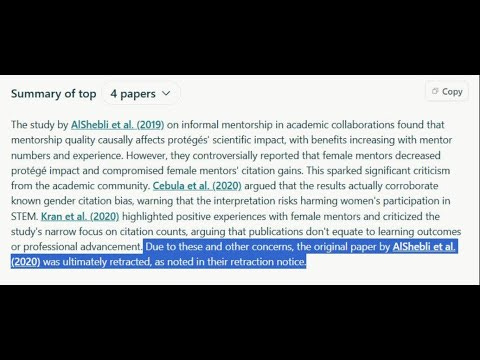
Introduction In my previous post I tested eight academic RAG or RAG‑like tools—Elicit, scite assistant, SciSpace, Primo Research Assistant, Undermind, AI2 Scholar QA, and several "Deep Research" modes from OpenAI, Gemini, and Perplexity—to see how they handled a well‑publicised 2020 paper that has since been retracted : “The association between early‑career informal mentorship in academic collaborations and

PersonalAutres sciences socialesAnglais
Publié
Auteur Aaron Tay

Musing sabout librarianship - Substack A Home Full of Memories—And a New Door Opening When I first hit “Publish” on Musings About Librarianship on Blogger back in 2009, I was a wet behind the ears librarian nervously sharing half-baked thoughts. I never imagined that my tiny blogger corner would grow into a gathering place for thousands of curious colleagues around the world.

Retrieval Augmented GenerationAi SearchRetractionsAutres sciences socialesAnglais
Publié
Auteur Aaron Tay

Academic Retrieval Augmented Systems (RAG) live or die on the sources they retrieve, so what happens if they retrieve retracted papers? In this post, I will discuss the ways different Academic RAG systems handle them, and I will end with some suggestions to vendors of such systems.Thanks for reading Aaron’s Musings about Librarianship!

Retrieval Augmented GenerationAi SearchAutres sciences socialesAnglais
Publié
Auteur Aaron Tay

May was a busy month for me in terms of output. [Article] Comparative review of Primo Research Assistant, Scopus AI and Web of Science Research Output First, I had two pieces of work published in the Katina Magazine that I am quite proud of. First, a comparative review of Primo Research Assistant, Scopus AI, and Web of Science Research Assistant—written by yours truly—was published.

Autres sciences socialesAnglais
Publié
Auteur Aaron Tay

As an academic librarian, I’m often asked: “Which AI search tool should I use?” With a flood of new tools powered by large language models (LLMs) entering the academic search space, answering that question is increasingly complex. Both startups and established vendors are rushing to offer “Deep Search” or “Deep Research” solutions, leading to a surge in requests to test these products.

Autres sciences socialesAnglais
Publié
Auteur Aaron Tay

Following my recent talk for the Boston Library Consortium, many of you expressed a strong interest in learning how to test the new generation of AI-powered academic search tools. Specifically, evaluating systems using Retrieval-Augmented Generation (RAG) was the top request, surpassing interest in learning more about semantic search or LLMs alone. This is a crucial topic, as these tools are rapidly entering our landscape.

Autres sciences socialesAnglais
Publié
Auteur Aaron Tay

Synopsis (Grok 3.0 aided) A new breed of "Deep Research" tools is reshaping how we tackle complex queries, moving beyond traditional search engines and quick AI summaries. From OpenAI’s Deep Research and Google’s Gemini counterpart to academic-focused players like Elicit, Undermind.ai and SciSpace, these agentic systems promise comprehensive reports and literature reviews—albeit with a much slower response.