ChimieAnglaisWordPress

Henry Rzepa's Blog

Henry Rzepa's Blog
Chemistry with a twist
Page d'accueilFlux Atom
language
Chemical ITChimieAnglais
Publié

I have had some interesting discussions recently regarding metadata. What emerges is that it can be quite a broadly defined concept and it is clear that a variety of answers might be obtained when asking the simple question “what is it useful for?” Here I set out some of my answers to that question.

Interesting ChemistryChimieAnglais
Publié

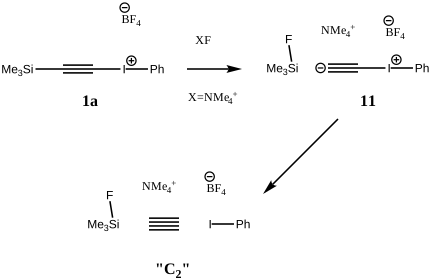
Although the small diatomic molecule known as dicarbon or C2 has been known for a long time, its properties and reactivity have really only been determined via its very high temperature generation. My interest started in 2010, when I speculatively proposed here that the related isoelectronic species C⩸N+ might sustain a quadruple bond.

Reaction MechanismChemistryComputational ChemistryImplicit SolvationKen HoukChimieAnglais
Publié

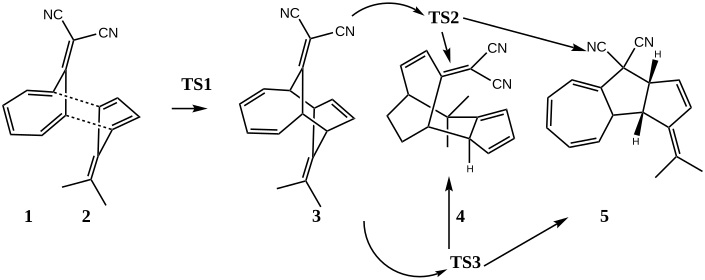
Ken Houk’s group has recently published this study of cycloaddition reactions, using a combination of classical transition state location followed by molecular dynamics trajectory calculations, and to which Steve Bachrach’s blog alerted me. The reaction struck me as being quite polar (with cyano groups) and so I took a look at the article to see […]

Interesting Chemistry019-1059-910.1038BiomoleculesChelating AgentsChimieAnglais
Publié

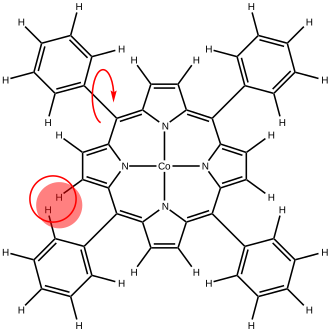
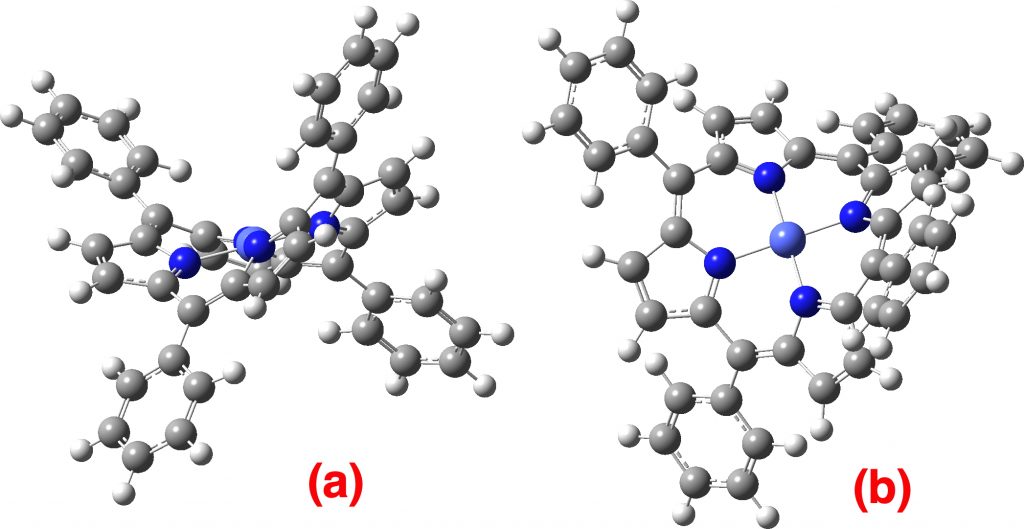
Previously, I explored (computationally) the normal vibrational modes of Co(II)-tetraphenylporphyrin (CoTPP) as a “flattened” species on copper or gold surfaces for comparison with those recently imaged. The initial intent was to estimate the “flattening” energy. There are six electronic possibilities for this molecule on a metal surface.

Interesting ChemistryAnionic Metal SurfaceCambridgeChemical BondingChemistryChimieAnglais
Publié

The topic of this post originates from a recent article which is attracting much attention. The technique uses confined light to both increase the spatial resolution by around three orders of magnitude and also to amplify the signal from individual molecules to the point it can be recorded.

Chemical ITAcademic PublishingAmerican Chemical SocietyAuthorBusiness IntelligenceChimieAnglais
Publié

The conventional procedures for reporting analysis or new results in science is to compose an “article”, augment that perhaps with “supporting information” or “SI”, submit to a journal which undertakes peer review, with revision as necessary for acceptance and finally publication.