ChimieAnglaisWordPress

Henry Rzepa's Blog

Henry Rzepa's Blog
Chemistry with a twist
Page d'accueilFlux Atom
language
Historical2001-2050Alfred NobelBill GriffithCountry: United KingdomChimieAnglais
Publié

The book of the title has recently appeared giving a rich and detailed view over 417 pages, four appendices and 24 pages of photographs of how a university chemistry department in the UK came into being in 1845 and its subsequent history of discoveries, Nobel prizes and much more.
Chemical ITHistorical10.5517Advertising & Marketing - NECChemical ContextChimieAnglais
Publié

Almost exactly 20 years ago, I started what can be regarded as the precursor to this blog. As part of a celebration of this anniversary, I revisited the page to see whether any of it had withstood the test of time. Here I recount what I discovered.

Interesting ChemistryReaction MechanismAccessible Activation Free EnergyAryneAzulenesChimieAnglais
Publié

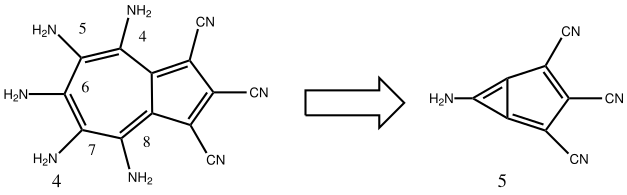
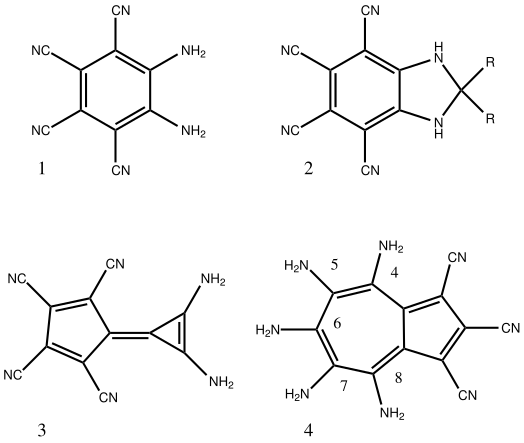
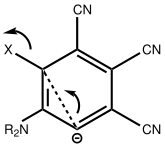
The story so far. Inspired by the report of the most polar neutral compound yet made, I suggested some candidates based on the azulene ring system that if made might be even more polar. This then led to considering a smaller π-analogue of azulene, m-benzyne.

Historical10.1021Aqueous SolutionChemical BondChemical BondingChimieAnglais
Publié

My holiday reading has been Derek Lowe’s excellent Chemistry Book setting out 250 milestones in chemistry, organised by year. An entry for 1920 entitled hydrogen bonding seemed worth exploring in more detail here. As with many historical concepts, it can often take a few years to coalesce into something we would readily recognise today, and hydrogen bonds are no exception.

Interesting ChemistryAryneAzuleneChemical PolarityChemistryChimieAnglais
Publié

A project fork is defined (in computing) as creating a distinct and separate strand from an existing (coding) project. Here I apply the principle to the polar azulene 4 explored in an earlier post, taking m-benzyne as a lower homologue of azulene as my starting point.